

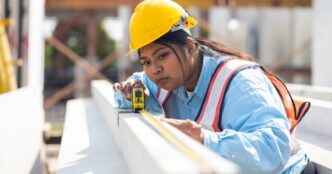
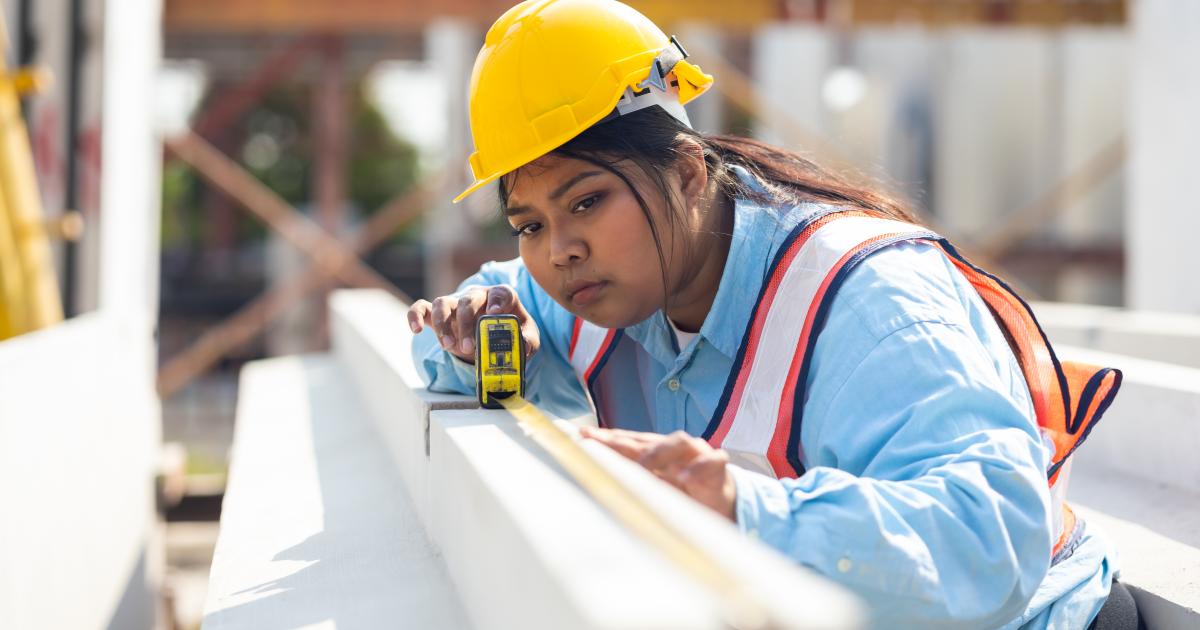
Black female worker wearing safety hardhat in a construction site.
Skills and labour shortages have become a major challenge for the construction industry in the European Union. In Sweden, where 10,000 workers retire from the industry each year, 50% of construction companies report difficulty finding skilled workers and six in ten have declined business due to shortages, according to the Swedish Construction Federation (Byggföretagen).
Attracting more women to construction is not only a matter of equality: it is essential for ensuring the sector’s future.
This was one of the central messages from the CoP 7 European Synergies webinar, organised by BUSUnited on 16 September, as part of the European Skills & VET Week.
A changing sector
Experiences shared by organisations from across Europe have highlighted the need for a comprehensive approach to women’s participation in the construction sector in order to retain this untapped workforce.
Recent changes in construction methods have widened the opportunities for women. Emerging roles, such as 3D construction printing operators or virtual site designers, have reduced the reliance on physical strength in favour of precision and coordination. However, stereotypes and lack of representation remain major obstacles for women.
A survey conducted by the project Construct Her Future (CoHER) indicates that 85% of young women interested in a career in construction say societal norms and biases are a major barrier to pursuing their aspirations.
Breaking old perceptions
Participants in the webinar noted that women need to see themselves represented across the industry, not only in traditionally female-associated roles but as carpenters, engineers, site supervisors, business owners and leaders.
“You can’t be what you can’t see. Narrative shapes identity. And construction on screen is still typically masculine, dangerous, manual, and rarely inclusive”, stressed Oksana Koshman, from Irish innovation, education and R&D centre Future Cast.
Initiatives like the Construction Woman of the Year award, organised by Byggföretagen, and the Eramus+ project European Women Empowered in Construction (WEC) are actively elevating female role models.
Looking at the whole journey
Attracting women into training or entry-level roles is only one part of the picture. If the sector wants lasting change, it has to pay equal attention to retention and progression.
“Knowing where girls and women drop off along the pipeline is key to finding effective solutions”, noted Sarah Rose Flynn, from the consultancy BluSpecs.
As highlighted by projects like Boss Ladies, run by the Danish non-profit organisation Foreningen Divérs, retention improves significantly when basic needs are met: workwear designed for women’s bodies, proper on-site changing facilities, and clear, enforceable anti-sexism policies.
“Women don’t need to adapt to construction but the construction sector has to adapt to be more inclusive of women”, agreed Beatriz Oliete, from Fundación Laboral de la Construcción, a Spanish organisation that promotes training, employment, occupational safety and professional development in the construction industry.
In the past six years, the number of female students entering VET programmes related to the construction sector increased from 19 to 49 in Denmark.
Join the Busunited CoP7 European Synergies and contribute to the exchange of knowledge and good practices across Europe. Complete the registration form to join.