


Vocational education and training (VET) plays a central role in equipping people with the skills needed in today’s economy. It provides learners with practical, job-ready skills in sectors with strong demand for workers, such as energy, manufacturing, healthcare, defence and construction.
The European VET strategy will
- support learners to get skills that drive innovation and growth through training on cutting-edge technology
- give learners access to careers with long-term prospects
A common direction for VET in the EU
The VET strategy puts forward 10 initiatives under the objectives of
- more flexible and higher-quality VET systems
- stronger links between VET, business and strategic sectors
- making VET more European and international
The main initiatives include
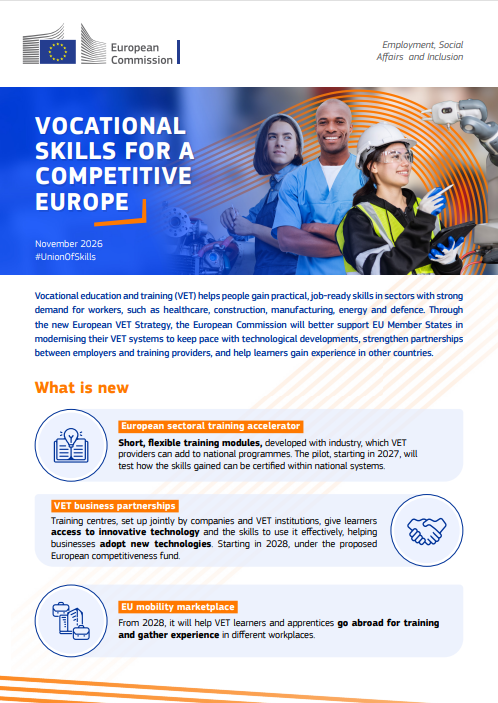
- European sectoral training accelerator with a pilot starting in 2027 to offer short, flexible training modules, developed with industry, which VET providers can add to national programmes
- VET business partnerships for new training centres, set up jointly by companies and VET institutions, to give learners access to innovative technology and the skills to use it effectively and help businesses adopt new technologies
- EU mobility marketplace to help VET learners and apprentices find training abroad and to support companies and VET schools in organising quality exchange opportunities
Learn more about the initiatives
Next steps
On 20 November, the Commission will host the 2026 European Education and Skills Summit to launch implementation of the Package alongside EU countries, social partners, school networks, teacher organisations, EdTech companies and pupils’ representatives.
Background
The Education and Skills package is a key contribution to the Union of Skills and aims to support EU countries to achieve the agreed 2030 EU-level targets.
The VET Strategy builds on the framework set out in the Council Recommendation on vocational education and training. It therefore focuses on key areas where the EU level can best support EU countries in their reforms and policies. In the 2025 Herning declaration, EU countries have already committed to modernise and make their VET systems strong and future-fit.
These actions are also aligned with the Apply AI Strategy, which focuses on supporting the adoption of AI across key strategic industries and the public sector, including education.
Related links and documents
Factsheet: VET Strategy
VET Strategy