

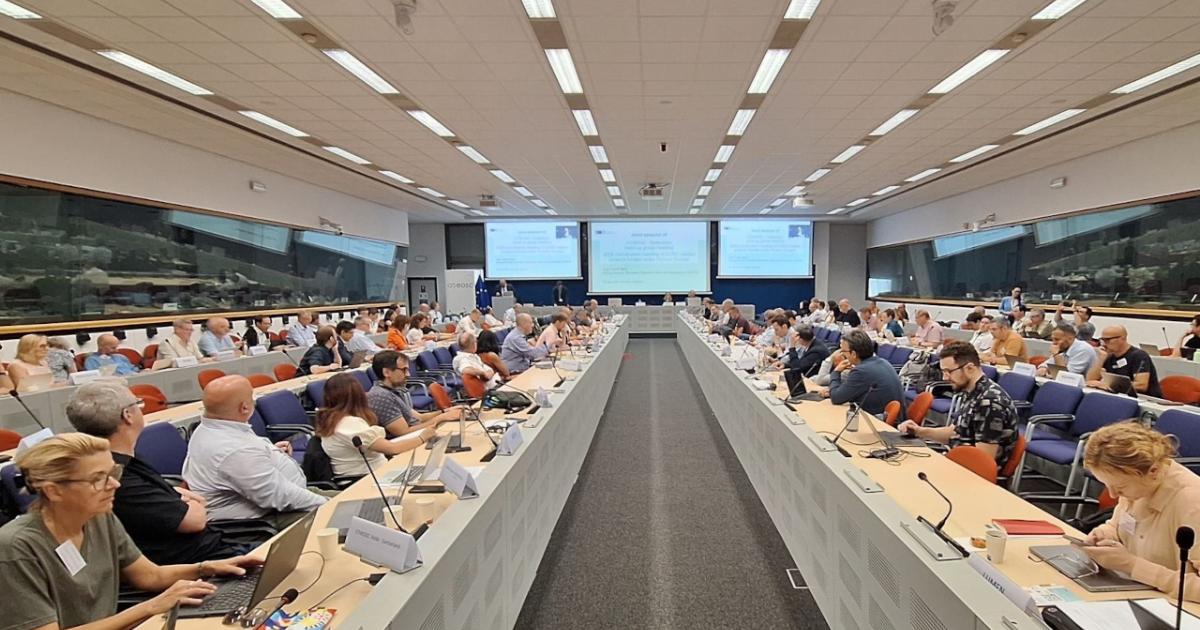
The European Commission welcomed the 28 EOSC Nodes of the EOSC Federation build-up group to their fifth in-person meeting on 7 and 8 July and representatives of 34 ongoing and forthcoming Horizon Europe-funded projects on EOSC to the fifth annual coordination meeting of EOSC projects on 8 and 9 July. The EOSC Tripartite Governance representatives from the EOSC Steering Board and the EOSC Association joined both meetings.
Both meetings in Brussels featured a joint session providing an opportunity to reflect on progress, strengthen collaboration and support the next phase of EOSC development. This comes at a time when EOSC is expanding rapidly, and the EOSC Federation is moving closer to fully operational mode.
A major milestone was the participation of representatives of the 14 second-wave EOSC Nodes selected by the EOSC Tripartite Governance in April 2026. These new Nodes broaden the national and thematic representation of the EOSC Federation and bring in new e-infrastructure capacities.
Moreover, 13 new projects funded under the Horizon Europe Work Programme 2025 came together for the first time. These new projects will help develop new ideas, strengthen research communities and explore future solutions for EOSC, including in Artificial Intelligence, skills and training, and the further development of the EOSC Federation.
EOSC is the Common European Data Space for research and innovation and as such a key part of the European Research Area and an important instrument for improving access to and reuse of research data, services and digital resources across Europe. As a trusted, secure and sovereign research data ecosystem, EOSC also contributes to Europe’s competitiveness and technological sovereignty.
The Commission’s commitment to EOSC remains strong. Under Horizon Europe, it is investing around 500 million Euro in EOSC, including support for the EOSC EU Node and around 50 projects, with further projects planned under the 2026 and 2027 Work Programmes. Looking ahead, the Commission’s proposal for Horizon Europe 2028–2034 foresees continued support for the FAIR agenda and for the further expansion and consolidation of EOSC.
As EOSC grows, close cooperation remains essential to ensure coherence and inclusiveness in a more complex environment. The joint session highlighted the shared commitment of all participants to work together to advance EOSC for Europe’s research community.
The 14 second-wave EOSC Nodes are:
- national EOSC Nodes in the Czech Republic, Croatia, Latvia, North Macedonia, Sweden, Slovenia, Switzerland, and Türkiye
- pan-European e-infrastructure EOSC Nodes through GÉANT, EGI, and Scholarly Commons (OpenAIRE and OPERAS)
- and thematic EOSC Nodes by METROFOOD-RI, EBRAINS RI, and ENVRI