


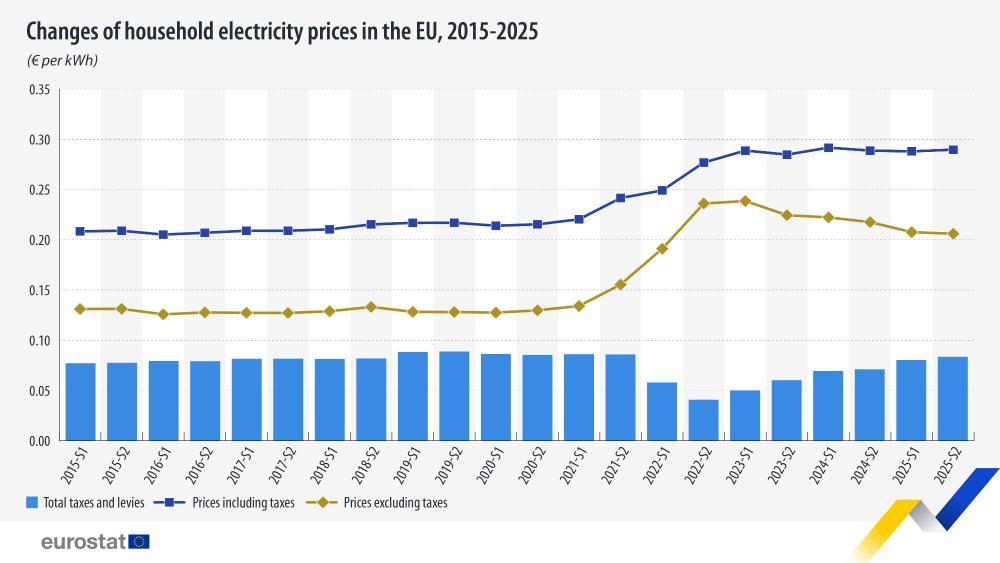
In the second half of 2025, average electricity prices for households in the EU remained largely stable, with…
Eurostat
10 posts


The EU’s greenhouse gas emissions fell by 0.4% in Q2 2025 (772 million tonnes CO2-eq), while GDP grew by 1.3%. The largest reductions were in Slovenia (-8.6%), the Netherlands (-5.9%), and Finland (-4.2%).


New Eurostat data reveals key economic & social trends across the EU! Discover the latest insights on growth, employment, and sustainability for October 2025. Stay informed with the freshest statistics shaping Europe’s future.


In the first half of 2025, the average electricity price for households in the EU remained largely stable at €28.72 per 100 kWh, following a -0.5% decrease from €28.87 in the second half of 2024. This continues the period of price stability, although the prices are still well above pre-2022 energy c


In the second quarter of 2025, 54.0% of net electricity generated in the EU came from renewable energy sources, an increase from the 52.7% registered in the same quarter of 2024.


Key figures on the EU in the world combines Eurostat data with international sources to provide a clear picture of the EU’s position in the global arena.


In 2023, the total final energy consumption in the services sector in the EU was 4 937 petajoules (PJ), down 1.9% compared with 2022 (5 069 PJ).


On 9 July, the European Migration Network published a comprehensive overview of asylum and migration trends in the EU, along with a Statistical Annex developed by Eurostat. This report provides an in-depth analysis of key developments in EU migration and asylum policy during 2024.


In 2024, according to preliminary data, the supply of renewable energy in the EU increased by 3.4% compared with 2023, amounting to around 11.3 million terajoules (TJ) in 2024.


The released data shows that 10 793 victims of human trafficking were registered in the European Union in 2023. It is a 6.9% increase compared to 2022. The increase could partly be due to more attention of the authorities and agencies to detect and identify victims of trafficking.