

Artificial intelligence (AI) is opening new possibilities for scientific discovery, from improving disease diagnosis and climate predictions to strengthening food security and accelerating innovation. Realising this potential, however, requires more than access to technology. It depends on reliable data, research infrastructure, skilled people and partnerships that enable African and European researchers to shape AI together and share in its benefits.
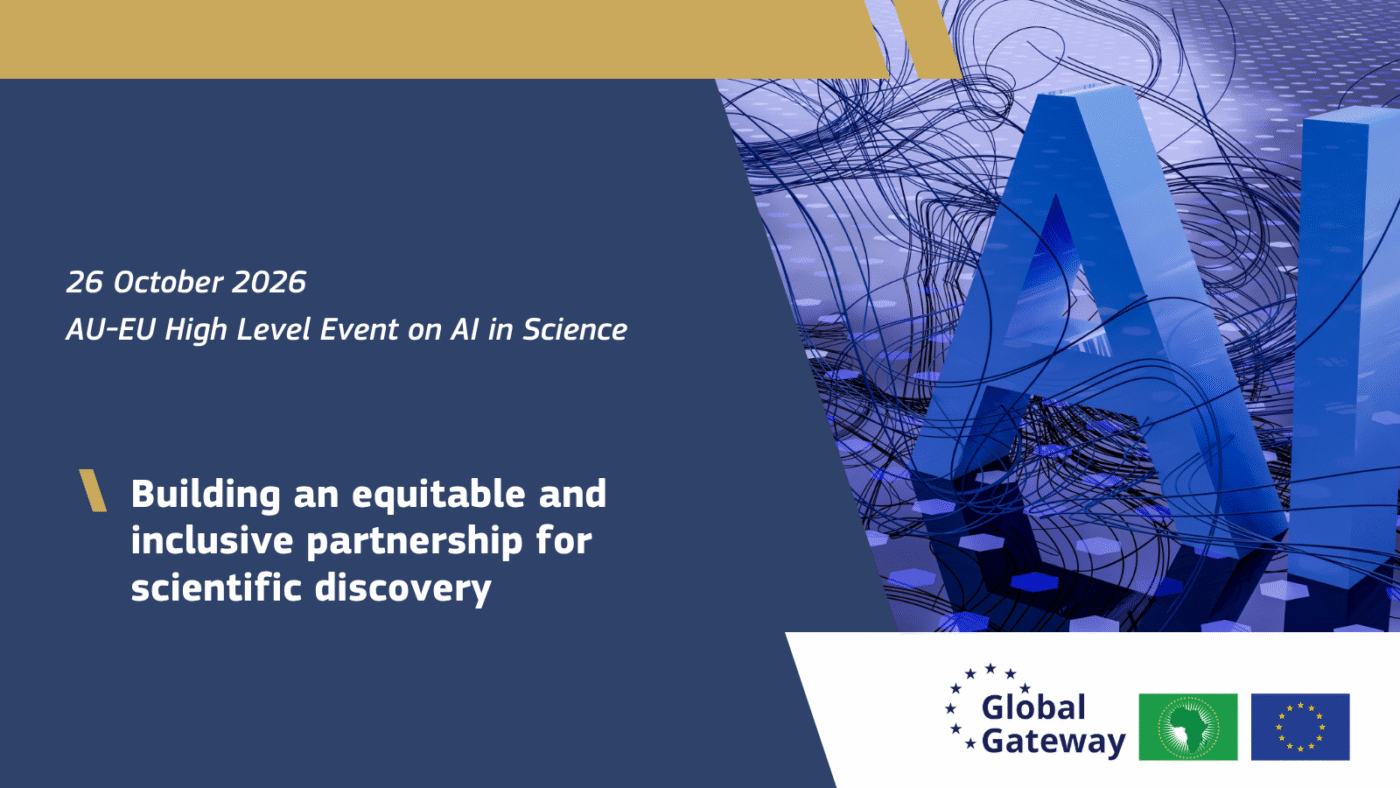
These were central messages of the AU–EU High-Level Event on AI in Science: Building an Equitable and Inclusive Partnership for Scientific Discovery, held online on 26 October 2026. The event examined how the African Union (AU) and European Union (EU) can strengthen cooperation in AI for science and identified priorities for future joint action.
Opening the event, Professor Saidou Madougou, Director for Education, Science, Technology and Innovation at the African Union Commission, highlighted AI’s potential to advance Africa’s development priorities under Agenda 2063, including public health, sustainable industrialisation, food security and environmental protection. He situated the discussions within the African Union’s Science, Technology and Innovation Strategy for Africa (STISA-2024) and Continental Artificial Intelligence Strategy, emphasising the importance of responsible, ethical and inclusive AI development.
Maria Cristina Russo, Deputy Director-General for Research and Innovation at the European Commission, highlighted the achievements of AU–EU research and innovation cooperation, which has supported approximately €6 billion in research and innovation activities, including work on malaria vaccines and treatments for HIV and tuberculosis. Building on the AU–EU High-Level Policy Dialogue on Science, Technology and Innovation and the AU–EU Innovation Agenda adopted in 2023, she identified AI in Science and Science Diplomacy as emerging areas of cooperation. She also presented the EU’s AI in Science Strategy and its Resource for AI Science in Europe (RAISE) initiative, highlighting opportunities for African researchers and innovators to participate in European research networks and funding programmes.
Professor Denise Pires de Carvalho, UNESCO Assistant Director-General for Sciences, highlighted the importance of ensuring that AI advances science for everyone, not only those with the greatest technological resources. Its contribution emphasised responsible governance, open science, academic freedom and gender equality, including the need to improve women’s participation and leadership in AI-related research. AI systems must also reflect diverse languages, cultures and knowledge systems, with transparent methods and appropriate safeguards to protect scientific integrity.
From scientific potential to practical cooperation
Four thematic discussions examined the conditions needed to advance AI in Science across Africa and Europe and identified several priorities for cooperation.
- Data and infrastructure: Researchers need access to high-quality, representative and interoperable datasets, alongside sustainable computing capacity and trusted data-governance arrangements. Participants called for stronger connections between existing research infrastructures rather than duplicating costly facilities, with particular attention to data sovereignty, local knowledge and the use of research findings in policymaking.
- Scientific networks: Existing AU–EU research partnerships in health, food and nutrition security, agriculture, climate and sustainable energy provide a foundation for joint AI research. Strengthening these networks will require predictable funding, African leadership, shared agenda-setting and equitable recognition of contributions from both continents.
- Innovation ecosystems: AI-based scientific solutions need pathways from research to practical application. Priorities included improving access to data, strengthening links between universities and businesses, supporting start-ups and technology transfer, and mobilising public and private financing. Solutions should be developed and tested with local users and adapted to their needs.
- Skills and talent: Developing AI capabilities requires investment in interdisciplinary education, research training, mentoring and opportunities for researchers to collaborate across institutions and countries. Participants also highlighted barriers to researcher mobility and the importance of brain circulation and sustained support for early-career scientists.
Sabine Henzler, Director Strategy of the European Commission’s Joint Research Centre highlighted cross-cutting requirements for progress, including trustworthy science, more equitable access to computing and innovation infrastructure, investment in interdisciplinary talent, and safeguards against AI narrowing scientific enquiry or weakening human oversight. Researchers must retain the expertise and critical judgement needed to assess AI-generated results and evaluate their reliability.
Building an equitable partnership for AI in science
For the EU, cooperation on AI in science is an opportunity to build on established research partnerships and address shared scientific challenges with African partners. Progress will depend on joint priority-setting, fair access to data and infrastructure, stronger scientific networks and sustained investment in people and institutions. It will also require African researchers and institutions to play an active role in shaping research agendas and developing solutions suited to their contexts.
The event’s recommendations will inform further work on AI in science as a priority for AU–EU research and innovation cooperation. They are expected to contribute to preparations for the next AU–EU Research and Innovation Ministerial Meeting in 2027.
By connecting scientific expertise, data, infrastructure and talent across both continents, the AU and EU can help ensure that advances in AI contribute to more effective research, better-informed public policy and sustainable development.