

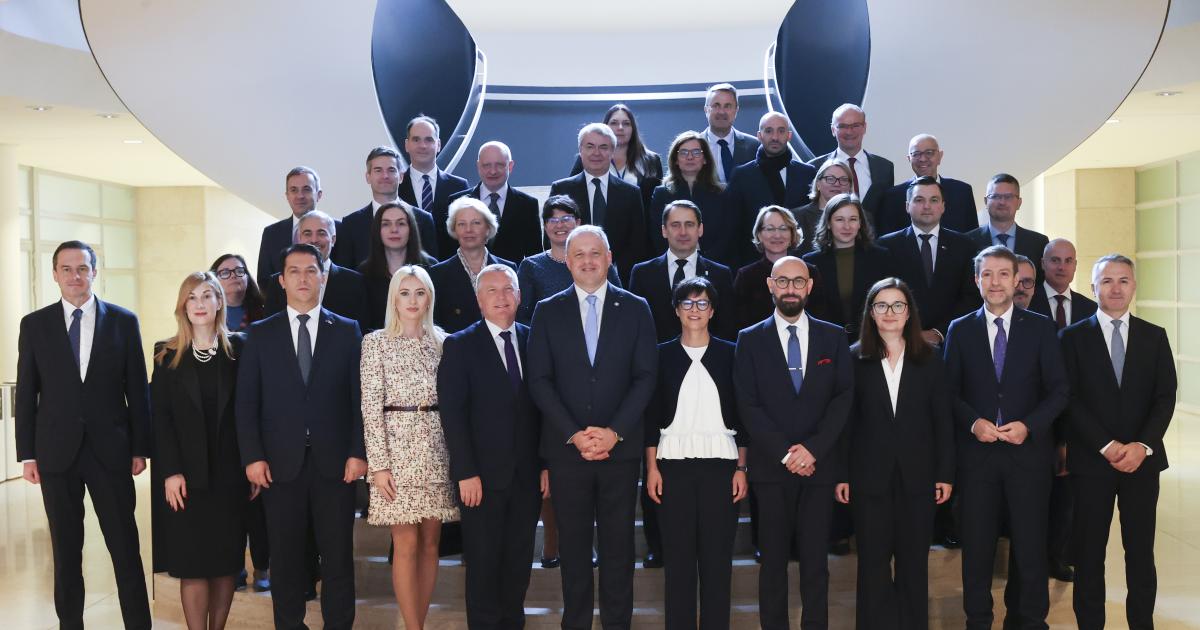
The European Centre for Democratic Resilience has taken an important step towards involving candidate countries and potential candidates in its work. In the margins of the General Affairs Council in Luxembourg on 13 October, EU ministers endorsed the association of Albania, Bosnia and Herzegovina, Moldova, Montenegro, North Macedonia, Serbia and Ukraine, together with Kosovo*.
Ministers discussed potential areas of cooperation with enlargement partners in future projects, including developing common concepts and methodologies for detection of foreign information manipulation and interference (FIMI), measuring democratic resilience, engaging in tabletop crisis management exercises, and supporting the safety of democratic life through dedicated trainings on the protection of journalists, civil society organisations, fact-checkers and politicians. Member States can now invite enlargement partners to propose, co-lead and participate in some of the Centre’s projects.
The participation of enlargement partners broadens the Centre’s practical cooperation and contributes to its core objectives to collectively improve the capacity to detect and anticipate threats to democratic resilience in Europe and its neighbourhood, to develop well-coordinated approaches and strengthen rapid response capacity, and to empower citizens, civil society and institutions to contribute towards democratic resilience.
The Centre, which was officially launched on 24 February 2026, is already delivering several concrete projects with Member States. In early September, a Training of the Trainers programme was rolled out with the Swedish Psychological Defence Agency, designed to help upskill government officials across Member States and strengthen whole-of-government and whole-of-society preparedness. The Centre has also launched the pilot phase of the Stakeholder Platform to test how the Centre can develop concrete projects for strengthening democratic resilience together with independent civil society organisations, media, fact-checkers, researchers, and media literacy professionals from across the EU.
* This designation is without prejudice to positions on status, and is in line with UNSCR 1244/1999 and the ICJ Opinion on the Kosovo declaration of independence.