

NEW YORK, 23 September 2026 — More than 160 million people risk being trapped in crisis without the longer-term support needed to rebuild their lives, restore livelihoods and access essential services, the United Nations Development Programme (UNDP) said today.
These people remain in humanitarian need but fall outside the 87 million prioritized for lifesaving assistance in 2026. As humanitarian partners focus resources on the most immediate and severe needs, development investment has a critical initial role to play alongside humanitarian action, helping people rebuild their lives and creating pathways to recovery.
In response, today UNDP launched the Moving Beyond Crisis Action Agenda, which calls for greater support and investment in development from the outset of a crisis. This means investing earlier and sustaining support for recovery so countries and communities can move beyond repeated cycles of crisis.
Its central proposition is simple: development should not wait for a crisis to end. By investing from day one, alongside humanitarian action, countries and communities can begin rebuilding sooner, reduce future humanitarian needs and strengthen resilience to the next shock.
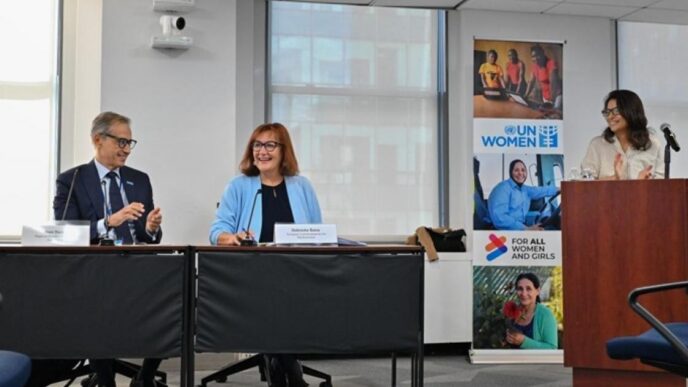
UNDP’s new agenda was launched at a high-level event convened by the Government of Lebanon, the European Union and UNDP during the UN General Assembly High-Level Week.
“For people hit by crisis, survival is only the first step. They also want to regain control of their lives. They want to work, send their children to school, reopen their businesses, and rely on institutions they trust. This work cannot wait until the crisis is declared over. That is why UNDP’s ‘Moving Beyond Crisis Action Agenda’ calls for development action from day one, helping countries move from emergency response to lasting recovery. Immediate humanitarian assistance saves lives, development helps people rebuild them,” said Alexander De Croo, Administrator of the UN Development Programme.
“The traditional sequence of relief, recovery and reconstruction no longer reflects the reality of today’s prolonged crises. In Lebanon, we are doing all three at the same time. The end of an emergency funding cycle cannot become the beginning of a recovery financing vacuum,” said H.E. Dr. Nawaf Salam, Prime Minister of Lebanon. “International support should strengthen the State’s ability to act, not build parallel systems around it.”
Ms. Dubravka Šuica, European Commissioner for the Mediterranean, said: “The European Union stands firmly with Lebanon and its people. With the adoption of the second €505 million tranche of our €1 billion package, we are supporting Lebanon’s recovery and reforms, strengthening its institutions and security, and helping protect the most vulnerable. A strong and sovereign Lebanon, with effective state institutions and the state exercising full control over its territory, is essential for lasting stability and prosperity. As Mediterranean partners, our futures are closely connected, and the EU will continue to support Lebanon on this path, as well as other partners in the region where we are focussing our efforts on early recovery and reconstruction.”
The need for this shift is growing. There were 61 state-based conflicts across 36 countries in 2024,
the highest number since the Second World War, while 117.2 million people are forcibly displaced
worldwide. At the same time, official development assistance fell 23 percent in 2025, the largest
annual decline on record.
As crises become more prolonged and interconnected and resources come under pressure,
humanitarian assistance alone cannot meet the needs of people living through prolonged crises.
Without functioning services, livelihoods, markets and institutions, people remain vulnerable to
further shocks and may need assistance for longer.
The Action Agenda also calls for development finance to be used more strategically in crisis settings.
Development finance can help reduce investment risks and bring in additional public and private
capital, including in places where risks are high and investment is urgently needed. UNDP has helped
align and mobilize more than US$ 63 billion in public and private finance across 27 fragile and crisis
contexts.
In Lebanon, EU-funded UNDP programmes are helping conflict-affected communities clear rubble
and unexploded ordnance, repair critical infrastructure and restore public services. In Yemen, UNDP
and the World Bank are working with local institutions to restore livelihoods and productive assets
and expand access to digital payments and financial services while the crisis continues. In Ukraine,
UNDP technical assistance has helped unlock US$ 1.6 billion in European Investment Bank financing
for schools, hospitals and critical infrastructure.
MEDIA CONTACTS
Aimee Brown, UNDP Crisis Bureau Communications Specialist: aimee [dot] brown undp [dot] org (aimee[dot]brown[at]undp[dot]org)
Guillaume Mercier, EU Spokesperson for Enlargement, International Partnerships and the
Mediterranean: Guillaume [dot] mercierec [dot] europa [dot] eu (Guillaume[dot]mercier[at]ec[dot]europa[dot]eu)