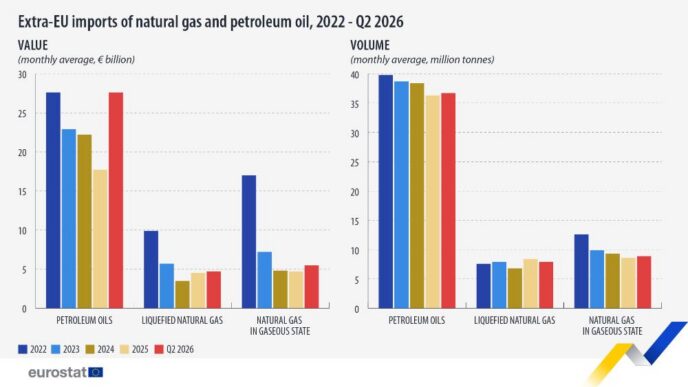


A macroeconomic analysis underlying the European Commission’s Spring 2026 Economic Forecast looks at a scenario of a significant and prolonged disruption to energy markets caused by the Middle East crisis, to complement the baseline projections.
The scenario assumes that trade through the Strait of Hormuz will resume only gradually from September 2026 and remain severely restricted through the end of 2026. Oil prices peak at around USD 180 per barrel in the fourth quarter of 2026, and gas prices at around EUR 80 per MWh. This is significantly higher than in the baseline scenario, where prices are USD 84.7 per barrel and EUR 42.2 per MWh over the same period.
Prices are then expected to gradually return to the baseline scenario over 2027 as production recovers, passage through the Strait of Hormuz is restored, and new liquefied natural gas capacity from other suppliers comes online.
By the end of 2027, energy prices are expected to revert close to baseline levels.
The impact on the EU economy
Higher energy prices are also assumed to raise global uncertainty risk premia, weighing on consumer confidence, and constrain global growth. These amplifying channels are imposed as additional exogenous assumptions in the model.
Considering all these channels together, EU GDP growth falls markedly relative to the baseline in both 2026 and 2027. In 2026, forecast growth is 0.4 percentage points lower (0.7% vs. 1.1%). In 2027, the gap widens to 0.7 percentage points (0.7% vs. 1.4%).
Inflation is projected to rise significantly, driven by the pass-through of higher energy costs. In 2026, inflation is 0.3 percentage points higher than in the baseline (3.3% vs. 3.0%). In 2027, the gap widens to around 1.1 percentage points (3.5% vs. 2.4%).
The impact in 2026 is more contained, as the scenario assumes commodity prices peak only towards the end of 2026.
The analysis reveals that the inflation impact is driven almost entirely by higher oil and gas prices.
The additional channels, in fact, slightly dampen inflation, as the demand-reducing effects of lower confidence and tighter financial conditions partially offset upward price pressures.
Break-down by main channels
Background
The macroeconomic assessment builds on the Global Multi-country model, the macroeconomic Dynamic Stochastic General Equilibrium model jointly developed by the JRC and European Commission’s Directorate-General for Economic and Financial Affairs (DG ECFIN), that regularly supports and inform macroeconomic analysis, policies and forecast. It supports the European Commission’s Spring 2026 Economic Forecast.
The model captures the key transmission channels from energy prices to the broader economy. Higher oil prices translate into increased energy costs for households and firms, reducing real disposable income and lowering consumption. The resulting inflationary pressure leads to tighter financial conditions or a longer period of restrictive monetary policy. The model uses historical data, including the 2022 energy crisis, and therefore reflects plausible substitution possibilities and empirically observed transmission mechanisms.