

On 16 July, the European Commission proposed a new Multiannual Financial Framework (MFF) with a budget of almost EUR 2 trillion – or 1.26% of the EU’s gross national income on average between 2028 and 2034. This budget aims to equip Europe with a long-term investment plan that matches its ambitions to be an independent, prosperous, secure, and thriving society and economy.
The budget will support people, businesses, Member States, regions, and partners, with a strong emphasis on promoting peace, prosperity and European values within a shifting geopolitical and economic landscape. The decision on the future long-term EU budget and revenue system will be discussed by Member States in the Council, with the Commission aiming to support a swift agreement.
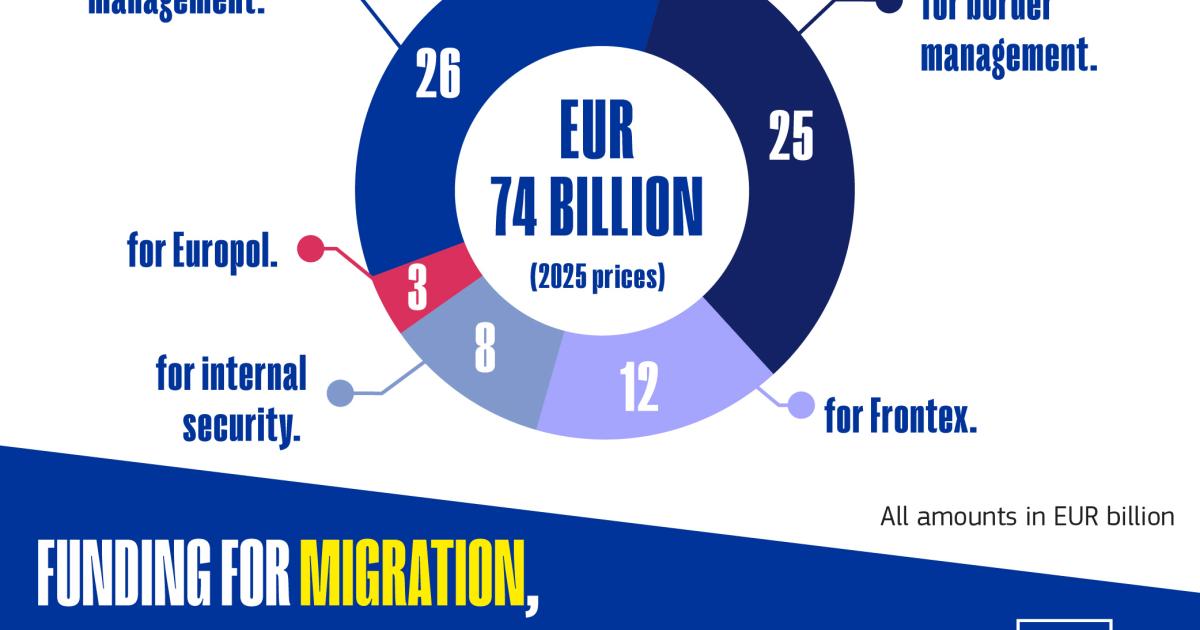
Among structural shifts in policy priorities, particular emphasis is put on the EU’s border and migration management, as well as its internal security. The Commission’s proposal includes a sizeable increase of the AMIF, BMVI and ISF Funds, tripling subsidies with a total of EUR 34 billion. With additional funding allocated from the EU Thematic Facility to strengthen EU agencies involved in these policy areas, the proposed funds mount to a total of EUR 74 billion.
These will be distributed as follows:
- EUR 26 billion for migration management;
- EUR 25 billion for border management;
- EUR 12 billion for Frontex;
- EUR 8 billion for internal security;
- EUR 3 billion for Europol.
The new budget is set to enable EU Member States to implement the Pact on Migration and Asylum, which will enter into application by mid-2026; to fully digitalise border control management; and to equip law enforcement authorities with modernised capabilities to fight terrorism and organised crime, both online and offline, as foreseen by the recently adopted Protect EU – Internal Security Strategy.