

None of this happens on its own. It depends on whether Europe’s regions have the conditions to compete, adapt to the green and digital transitions, and close the gaps between them. Increasingly, it also depends on strategic autonomy: whether Europe can develop and adopt the technologies it needs, rather than relying on others to build them first. Cohesion policy is helping regions build the ecosystems and skills they need to take part, treating innovation as an investment for every region.
Building the conditions for innovation
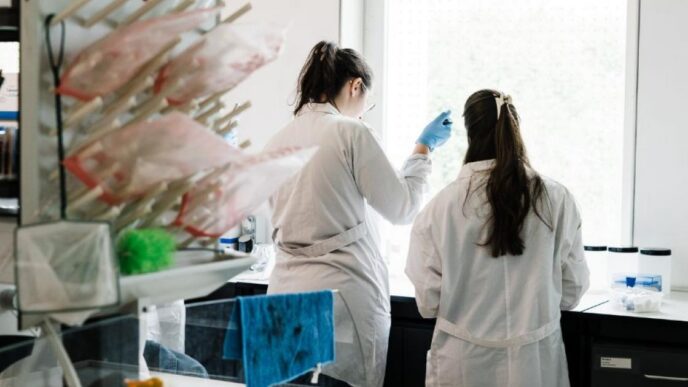
Innovation needs more than smart ideas. It requires the research facilities, skills, digital connections and links between businesses and universities that allow an idea to be developed, tested and put to use. Cohesion policy invests in these foundations, from research infrastructure and university facilities to technology centres, digital connectivity, business incubators, skills and support for innovative businesses.
For a region, that can mean giving a researcher the facilities to test an idea, helping a small company work with a university for the first time, or giving workers the skills to use a new technology. These foundations can help businesses turn knowledge into new products and services, create quality jobs and make local economies more resilient.
Under the 2021-2027 programmes, Member States have programmed around € 75 billion of ERDF resources, alongside a further € 36 billion in national co-financing to reach the policy objective of a ‘Smarter Europe’. Between 2014 and 2020, ERDF support contributed to close to 79,000 scientific publications, more than 75,000 partnerships between businesses and research institutions, and over 7,000 patents.
Starting from strength
Cohesion policy does not ask every region to compete in the same fields. Through Smart Specialisation Strategies (S3), regions identify their own strengths and opportunities, whether in advanced manufacturing, health innovation, agri-food or clean technology, and shape their investment around them. It is a place-based approach to innovation, not a single model applied everywhere. Regions need different pathways to strengthen their economies and take part in the green and digital transitions.
The Smart Specialisation Study 2021–2027 found that two in three respondents consider S3 the main framework for research and innovation policy in their region. Lombardy shows what this can look like in practice. Rather than organising its strategy around individual industries, the region has built its priorities around broader themes and innovation ecosystems, including sustainability and digitalisation. These are revisited every two years, so the strategy can adapt as technology and markets change. This has allowed Lombardy to incorporate new EU technology priorities into its existing strategy rather than starting again from scratch.
From regional priorities to strategic technologies
These regional priorities are now being channelled into one of the EU’s newest strategic initiatives: the Strategic Technologies for Europe Platform (STEP). Europe cannot afford to fall behind on the technologies that will define the next decade, so STEP backs the development and manufacturing of critical technologies in digital and deep tech, clean and resource-efficient technologies, and biotechnology, while also addressing the skills shortages that could hold these technologies back. The unwavering aim is to strengthen the EU’s economic resilience and strategic autonomy.
Cohesion policy helps fund that ambition on the ground, through the ERDF, Cohesion Fund, Just Transition Fund and ESF+. Uptake has been fast: 21 ERDF programmes had already incorporated specific STEP-related objectives by January 2025, before STEP had even become fully operational. By the end of March 2026, close to € 15 billion in EU support, representing € 17 billion in total cost, had been allocated.
In Poland, € 25 million from the ERDF helped the Mazowiecki Szpital Bródnowski build an Interventional Neurotherapy Centre pioneering gene therapy for Parkinson’s disease. In Denmark, € 4.6 million from the Just Transition Fund is backing HYFLEX, which uses surplus renewable electricity from an existing solar park to expand hydrogen storage and reduce the energy costs of large-scale electrolysis.
The projects are very different, but that is precisely the point. STEP is not about making every region pursue the same technology. It allows cohesion investment to support strategic technologies according to the strengths and opportunities of different places.
Closing the innovation gap
Innovation does not belong only to Europe’s biggest cities or best-established research hubs. Czechia, for example, took a different starting point in its 2021-2027 strategy, focusing first on skills, public-private cooperation, innovation infrastructure and governance. Its national innovation system was still developing and needed these foundations before sector-specific specialisation could work.
From 2014-2020, ERDF-supported research in Estonia and parts of Portugal produced some of the highest numbers of patents per capita in Europe, despite lacking the scale of Europe’s largest research hubs. Central and eastern EU regions also saw faster growth in scientific publications than their western counterparts over the same period. The innovation gap is still real, but these trends suggest that it does not have to be permanent.
An innovation strategy for every region
Innovation is central to Europe’s long-term prosperity, but its benefits cannot be confined to the regions that already have the strongest research base. By backing research, skills and technology adoption across different types of regions, and allowing each to build on what it does best, cohesion policy is helping to spread the capacity to adapt and innovate.
The aim is not for every region to become a technology hub. It is to ensure that all of them have a stake in what comes next.