

Along the windswept Pomeranian coast, Ustka is a town shaped by the sea. For generations, fishing defined daily life here, leaving a legacy that still lives in the harbour, the streets and the memories of local people.
Driven by a vision to revive local identity and reconnect residents and tourists with maritime culture, a series of small projects supported by the European Maritime and Fisheries Fund (EMFF) has brought that heritage back to life. Through reenactments, interactive exploration and open-air art, Ustka has turned its fishing heritage into a living, year-round story.
A calling rooted in the sea
In Ustka, the sea is more than a landscape. Fishing was part of the town’s identity, rhythm and values. Local partners set out to make this heritage visible again, not as something distant or nostalgic, but as something people can experience for themselves.
“People often forget how much work, patience and respect for the sea stand behind every fish,” says Aleksandra Klimczuk from the Słowińska FLAG. “These projects help them see the profession differently, and that fish do not just come from a factory or supermarket.”
Bringing the past to life
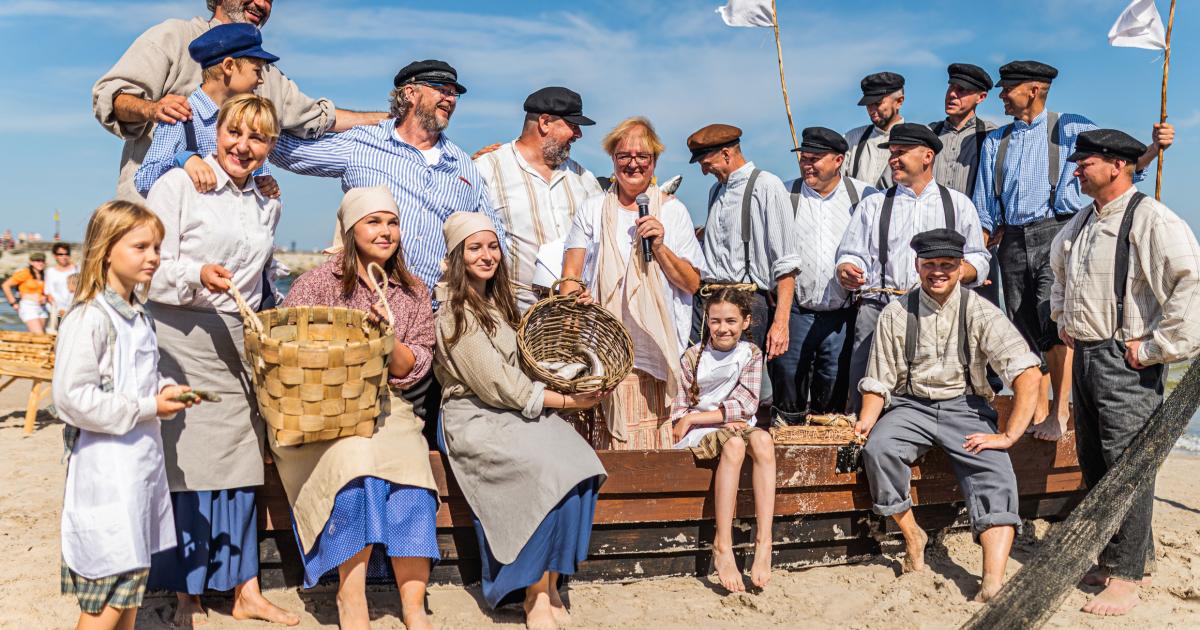
One of the most striking moments came during the town’s annual Fish Harvest Festival of the Sea, a festival celebrated for 11 years. With EU funding support for the August 2022 edition, the Municipal Office of Ustka transformed the event into an immersive historical showcase. Guided by an ethnographer researching early twentieth-century Pomeranian clothing and fishing gear, local actors staged the return of traditional wooden fishing boats to the harbour.
The two-day festival drew large crowds and gave visitors a vivid glimpse of life by the Baltic in the early twentieth-century. It was a reminder of the people, skills and hard work behind the coastal way of life.
Exploring heritage through play
The story continued in the streets. Through interactive treasure hunts such as The Tales of the Little Mermaid and Ustka Time Machine, families were invited to discover the town in a new way. Old fishers’ huts, historic granaries and harbour landmarks became part of a playful route through local history.
Developed with the community and distributed through the tourist information centre, the games helped children and parents uncover the town’s roots while supporting tourism. By following clues, decoding legends and searching for hidden fish bas-reliefs, they turned a walk through Ustka into a journey through time.
Sharing memories across generations
A permanent open-air photo exhibition on the route to the port added another layer to the story. Created from archival images gathered from German institutions, the Museum of Düsseldorf and local Polish archives, it offers a quiet but powerful dialogue between Ustka’s pre-war past and its present identity.
“Black-and-white photographs are universal,” says Katarzyna Kasperska of the Global Culture Foundation. “They need no translation. They help us understand the past and build a common future.”
Sparking new ideas and lasting prosperity
By connecting festival traditions, youth quests and outdoor storytelling, Ustka’s projects have inspired new installations, a published book and a regional theatre performance. Together, these small projects have strengthened local pride, boosted off-season tourism and shown that fishing heritage can still inspire new forms of community life.
In Ustka, EU support has brought scattered initiatives into one coherent story, proving that honouring fishing traditions is key to a vibrant, sustainable future for coastal communities.