


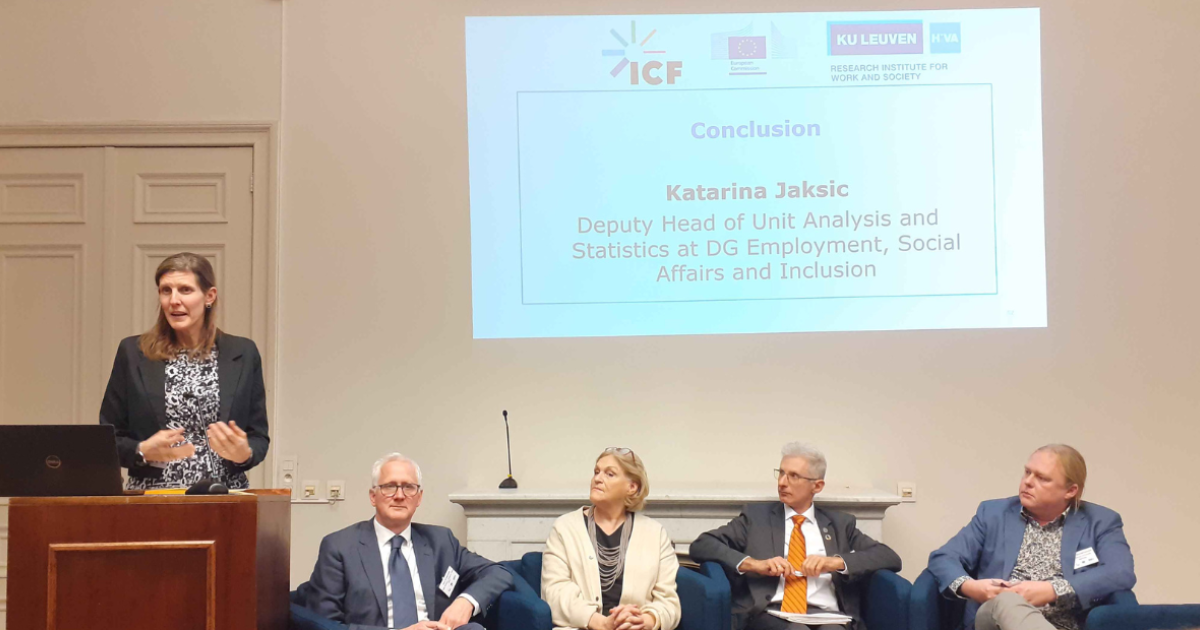
On 27 November, the Social Situation Monitor organised an in-person only research seminar on social resilience. It brought together 36 participants including the SSM team, speakers, academics, PhD students, and colleagues from EMPL, ECFIN, and SG REFORM. The seminar was opened by Elva Bova (Head of Unit F4, DG EMPL) and Alex Stimpson (Project Director of the SSM at ICF).
It consisted of a keynote speech by Ive Marx (University of Antwerp) followed by two round table sessions featuring a total of 7 speakers:
- Herwig Immervoll (OECD)
- Alexandre Daniel Calado (Instituto Universitário de Lisboa)
- Michele Raitano (Sapienza University of Rome)
- Péter Benczúr (Joint Research Centre)
- Rense Nieuwenhuis (Stockholm University)
- Bea Cantillon (University of Antwerp)
- Paolo di Caro (Italian Ministry of Economy and Finance)
Key messages
- Considerable improvements have been observed across Europe in the last decades: employment at historic highs, unemployment at historic lows. Poverty decreasing, especially severe material deprivation. In some Member States, real income increased threefold. Progress detected also in terms of policies. There is ample room for optimism.
- Resilience is a multidimensional concept (economic, social, environmental, cultural). It is considered an ability to deal with shocks as well as transformations.
- Governments often see resilience as equipping workers with skills needed in the labour market, while for individuals it is about shifting resources to deal with new risks and shocks – e.g. young adults moving back in with parents, who in turn can fall into poverty as a bigger household relies on pension income. Families and communities are two additional meso-levels to be considered in the study of resilience.
- Temporal dimension: Resilience has several aspects that come into play depending on the severity and duration of a crisis. A smaller, shorter crisis may only require absorptive capacity, while a longer one requires adaptive capacity, with flexibility and readiness for small changes. An extreme crisis, where adaptation would be unsustainable, will require transformation.
Labour market resilience:
- Labour market resilience decreased over the years with labour income inequality increasing and labour income share in total income decreasing.
- Geopolitical shocks can have both winners and losers. For example, some regions which are traditionally richer but are focused on single industries e.g. car manufacturing, have struggled in recent years. At the other end of the spectrum, a crisis can be an opportunity to develop new effective tools, such as the Recovery and Resilience Facility.
- Old trade-offs no longer valid: there is increasing evidence that higher wages lead to higher productivity as firms are incentivised to innovate. In the last 30 years there was a strong flexibilisation of the Italian labour market while innovation and productivity stagnated. The problem of ‘short-termism’, where frequent changes to the labour code favour employing people on short-term contracts also contributes to lower investment and productivity of firms.
- Quality jobs are key to ensure resilience of workers during shocks: The role of employment growth in tackling poverty may be overstated. First, those who enter employment are usually on a better trajectory with regards to previous employment, health, or activity. Second, the ‘added worker effect’, where the breadwinner of a family losing their job leads to the other person joining the workforce, is rare due to gender roles and care commitments within families.
Social resilience:
- Lowest income groups are both hardest hit during crises and can take the longest to recover, resulting in increased inequality.
- Evidence shows that countries whose minimum income schemes already had wide coverage find it easier to scale up in response crisis, while others are more reliant on poorly targeted, expensive ad hoc schemes. As it can be difficult to implement extensive reforms in a crisis, creating solid foundations and building contingencies during good times can help governments when shocks hit. Member States must maximise benefit take-up; less targeted measures have proven to be more efficient than the counterfactual.
- It is important to study coverage, adequacy, and take-up of benefits in quantitative analysis. Existing surveys may need to be complemented by administrative data.
Policy layering is needed: a mix of wage floors as high as labour market conditions allow, universal child benefits, social assistance schemes, and targeted income supplements differentiated by housing situation and children’s needs.