

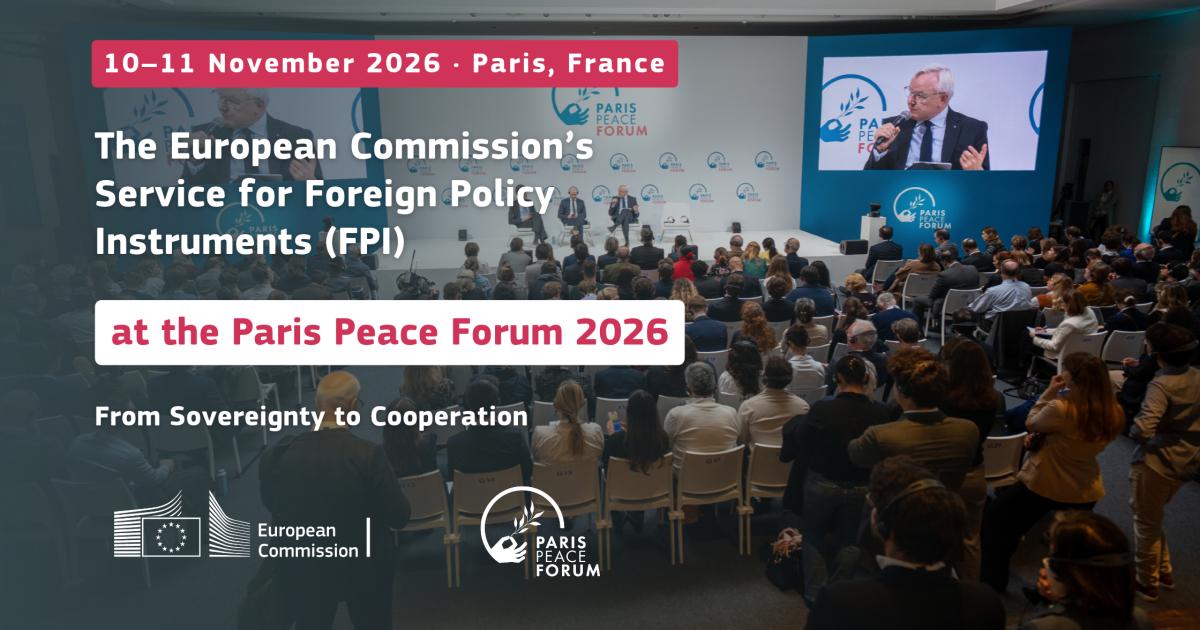
The European Commission’s Service for Foreign Policy Instruments (FPI) will put the spotlight on how peace mediation is adapting to a changing world at the Paris Peace Forum 2026, with its thematic panel “Peace Mediation Today: New Actors, New Coalitions, Lasting Results” on 10 November.
In 2025, the Uppsala Conflict Data Program recorded 65 armed conflicts involving states, the highest number since its records began in 1946. As pressure mounts to find lasting solutions, a growing number of actors are stepping in to open channels for dialogue and bring parties to the table.
In this context, the Paris Peace Forum (PPF) returns for its ninth edition on 10–11 November 2026 at the Palais de Chaillot, under the theme “From Sovereignty to Cooperation”. The Forum brings together governments, international organisations, civil society, academia and the private sector to build joint responses to today’s global challenges.
FPI’s participation is an expression of the European Union’s commitment to multilateral cooperation for peace. It reflects the EU’s conviction that, as conflicts multiply and common ground becomes harder to find, effective mediation depends on strong partnerships. For FPI, the Forum offers a valuable platform to work with established and new partners on fresh approaches to mediation and conflict prevention.
On 10 November, FPI’s thematic panel “Peace Mediation Today: New Actors, New Coalitions, Lasting Results” will examine how peace mediation can adapt to an increasingly crowded environment. States, regional and multilateral organisations and non-state actors play different roles and bring different strengths. The discussion will explore how they can work together more effectively and make their efforts more complementary.
The way peace is reached is changing too. As mediation increasingly focuses on incremental arrangements rather than comprehensive peace agreements, progress often comes step by step, through efforts to manage violence and de-escalate tensions. These arrangements can help reduce violence, but sustained engagement is essential if they are to contribute to lasting peace.
Helping such progress hold is at the heart of FPI’s work. FPI’s panel will look at what it takes to make those arrangements last, and where European support can add the most value. This session will explore how mediation and mediation practices are evolving on the ground, examine the complementarity between state mediators, private actors and regional and multilateral organisations, and consider where existing tools and sustained engagement can make the greatest difference in supporting political solutions that endure.
Over the past decade, the EU has financed more than 1,000 crisis response and conflict prevention projects worldwide. In a more fragmented world, the EU will continue to work with partners and invest in mediation. The discussions in Paris are a chance to bring these efforts closer together and to turn hard-won progress towards peace into lasting results.
Follow FPI’s coverage of the Paris Peace Forum on LinkedIn, X and Bluesky.