

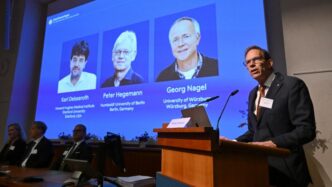
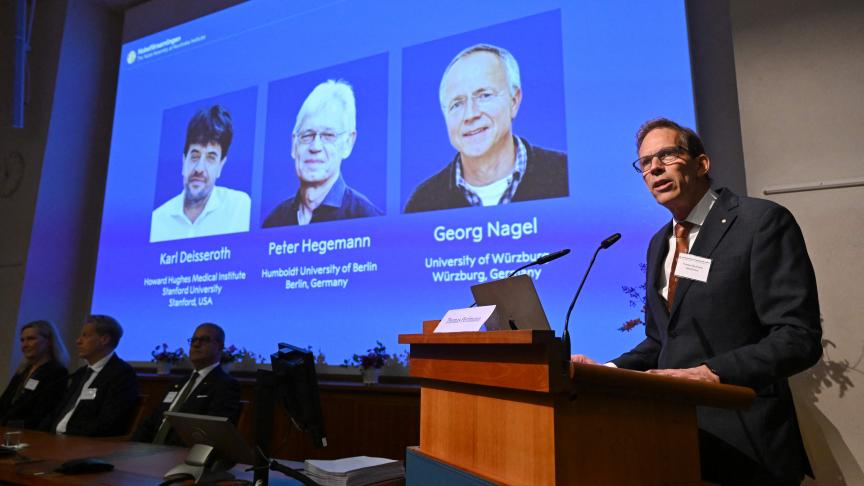
Peter Hegemann, who received two European Research Council (ERC) grants and participated in a Horizon 2020 Future and Emerging Technologies (FET) project, was today awarded the 2026 Nobel Prize in Physiology or Medicine, jointly with Karl Deisseroth and Georg Nagel, for their discoveries concerning light-gated ion channels and optogenetics.
Their discoveries made it possible to control the activity of nerve cells using light, transforming how scientists investigate the brain and its functions.
Professor Hegemann, from Humboldt University of Berlin, received €2.4 million through an individual ERC Advanced Grant for the MERA – Mechanism of Enzyme Rhodopsin Activation project (2016-2021), which investigated how a light-sensitive protein functions and its potential applications in optogenetics.
He is also a grantee, together with two other researchers, in the ongoing SOL – Switchable rhodOpsins in Life Sciences project (2022-2028), supported by an ERC Synergy Grant with total EU funding of almost €8 million. The project aims to develop light-controlled molecular switches that provide new tools for investigating cellular functions.
Professor Hegemann also contributed to STARDUST project (2017-2022), which received €3.8 million in EU funding, divided between 10 participants, to investigate an ultrasonically powered implant combining optogenetics, electrophysiology and pharmacology for potential applications in Parkinson’s disease.
All three projects were funded under Horizon 2020, the predecessor to the EU’s current research and innovation programme, Horizon Europe.
Ekaterina Zaharieva, Commissioner for Startups, Research and Innovation:
“Congratulations to Peter Hegemann, Karl Deisseroth and Georg Nagel. Their discoveries have transformed our ability to study the brain. The European Union is proud to have supported Professor Hegemann. His achievements show why giving scientists the freedom to pursue bold ideas can open entirely new fields of knowledge and create opportunities for future medical advances.”
Background
The EU has a longstanding record of supporting scientific excellence, with at least 33 Nobel Prize laureates having benefited from its research and innovation funding. This includes 16 ERC-funded researchers who subsequently won a Nobel Prize, counting Peter Hegemann, while 23 Nobel laureates have participated in the Marie Skłodowska-Curie Actions as fellows, supervisors or project coordinators.
Established by the European Union in 2007, the European Research Council supports excellent frontier research across all scientific fields. It funds researchers of any nationality to pursue ambitious projects at institutions across Europe, selecting proposals on the basis of scientific excellence.
ERC Advanced Grants support leading researchers with a track record of significant research achievements. Synergy Grants enable groups of researchers to combine complementary expertise to address scientific questions that individual teams could not tackle alone.
The ERC currently forms part of Horizon Europe, the EU’s research and innovation programme for 2021-2027.