

Europe’s circular economy transition is changing what is expected from goods, services and businesses. Products need to last longer, use resources more efficiently, contain fewer harmful substances, and generate less waste. At the same time, consumers need reliable information to identify better options in a market where environmental claims proliferate. This is where the EU Ecolabel fully plays its role!
Circularity built into EU Ecolabel product criteria
As the EU advances on the Circular Economy Act and implements the Empowering Consumers for the Green Transition Directive, the EU Ecolabel acts as a practical tool for linking policy objectives to everyday market choices.
Circularity starts at the design stage. The choice of materials and ingredients, the durability of a product, its reparability, its chemical profile, and its end-of-life options all influence whether resources remain in use or become waste.
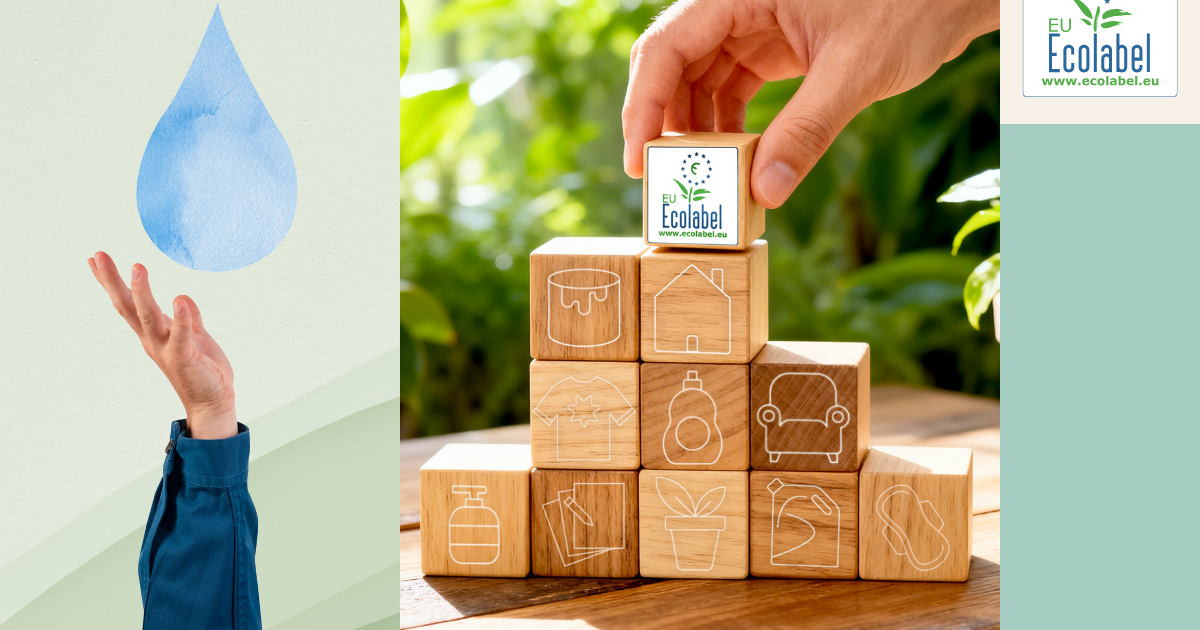
EU Ecolabel criteria address these issues across a wide range of product groups.
- For cleaning and detergents products, criteria cover packaging, dosage and restricted use of hazardous substances.
- For paper products, the label supports responsible fiber sourcing, lower emissions, and better resource efficiency.
- Tourist accommodation services can be awarded the EU Ecolabel when meeting criteria on energy, water, waste reduction and responsible management.
- For textiles, the label promotes restrictions on hazardous substances, durability, and reduced environmental impacts during production.
- For furniture, criteria address material sourcing, product lifetime, repairability, and emissions.
- For cosmetics, criteria include prohibition of unnecessary packaging and use of recycled material, as well as renewable ingredients of sustainable origin.
- For paints, it is requested to inform on how to minimise product wastage.
These examples demonstrate how the label translates circular economy principles into concrete requirements. It does not simply reward a final product; it pushes better choices across its life cycle.
The EU Ecolabel’s role in supporting circularity and competitiveness was discussed during the EU Circular Talk “The EU Ecolabel as a tool boosting circular economy and competitiveness“, held in March 2026. The event, co-organised by the European Circular Economy Stakeholder Platform (ECESP) and the EU Ecolabel (European Commission), brought together 10 speakers among policymakers, industry representatives and sustainability experts and attracted over 250 online attendees interested in exploring how this certification helps businesses adapt to a more circular market.
The EU Ecolabel Team Leader at the European Commission, Małgorzata Gołębiewska, noted: “The EU Ecolabel works like a circularity sandbox, where businesses test, validate and market sustainable products, de-risking tomorrow’s regulatory hurdles. For SMEs and multinational businesses alike, it is a smart way to turn compliance into a competitive advantage.”
The EU Ecolabel is a sign of environmental performance, but it also helps companies align with EU environmental objectives, anticipate future EU rules, strengthen product design, and make circularity visible to customers.
Trust in a crowded sustainability market
Credibility is central to the circular transition. Circular goods and services will only gain market traction if consumers, companies, and public authorities can rely on the information they receive.
The Empowering Consumers for the Green Transition Directive responds to a growing challenge: consumers want to make more sustainable choices, but they need information they can trust. Environmental claims are everywhere. Without credible verification, it can be difficult to separate serious environmental performance from vague or misleading messages. The EU Ecolabel helps address this gap: the Directive refers to the EU Ecolabel as a proof of recognised excellent environmental performance, giving consumers a clear sign that a product has been assessed against transparent and demanding environmental criteria.
For businesses, the label offers a credible way to communicate environmental commitment. For consumers, it reduces uncertainty. For public buyers, it supports greener procurement decisions by providing ready-made environmental criteria.
Melanie Kenway, RESH Director for Global Environmental Processes at Essity, noted at the EU Circular Talk:
“The EU Ecolabel certification scheme aligns with Essity’s strategy when it comes to lifecycle perspective, because it offers third-party verification that our products offer reduced environmental impacts, without compromising hygiene or functionality. It is a powerful and credible tool.”
Evidence of a wider circular economy link
A recent scientific research analysing the relationship between EU Ecolabel diffusion among EU countries and circular economy performance adds further weight to this policy and market perspective. The research found a positive association between EU Ecolabel uptake and circular material use rates. In practical terms, countries with higher diffusion of the EU Ecolabel also tend to perform better in keeping materials in productive use and reducing reliance on virgin resources.
The study suggests that EU Ecolabel diffusion can reflect wider circular economy readiness: stronger institutions, more active sustainability policies and markets that are better prepared to reward environmental performance.
This makes the EU Ecolabel relevant beyond the point of sale, as part of a broader framework that connects product policy, consumer information, business innovation, and circular economy governance.
A practical tool for Europe’s green transition
Circularity only works when it can be applied. The EU Ecolabel helps bridge that gap. It translates environmental and circularity objectives into verifiable criteria; it supports better product design, and it offers consumers reliable information to better guide their choices.
It is a win-win for all.
In a circular economy, credibility matters as much as ambition. The EU Ecolabel delivers both.
For more information, follow us on LinkedIn or consult the EU Ecolabel product catalogue. You can also read further with these resources: