

Climate change and the degradation of marine ecosystems are putting immense pressure on Europe’s waters and coastlines. At the same time, the production of biofuels and bioplastics relies heavily on land-based biomass, creating competition for arable land, freshwater and fertilisers.
This is why the Ocean Gardens project focuses on seaweed aquaculture in the open ocean and tackles the sector’s lack of cost-effective technologies for offshore seaweed farming and precise environmental impact data.
Coordinated by the MacroCarbon SL in Spain and co-funded by the European Maritime, Fisheries and Aquaculture Fund (EMFAF), Ocean Gardens project connects experienced partners in marine research and innovative technology from Spain and Germany. The project focuses on farming diverse native seaweed species in Gran Canaria in the Canary Islands using innovative floating techniques such as 3D printed holdfasts and biodegradable mesh, while assessing the environmental benefits and the replicability of this technology in other EU sea basins.
As Dr. Mar Fernández-Méndez, Ocean Gardens coordinator, explains:
“The ocean offers an extraordinary opportunity to produce the sustainable biomass our industries need, without placing additional pressure on agricultural land and freshwater resources. Through Ocean Gardens, we aim to make offshore seaweed cultivation a viable reality, while ensuring that its environmental benefits are scientifically assessed.”
From a pilot model to a large-scale aquafarm
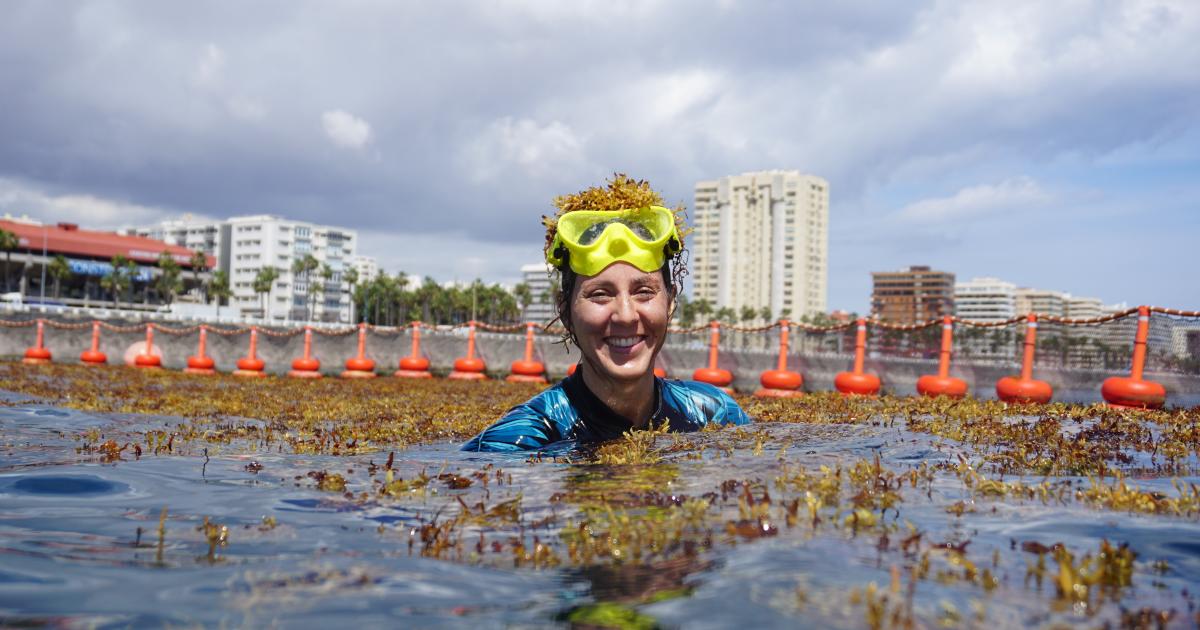
Since the start of the project in October 2025, the first 2 000 m2 modular aquafarm has been established in Las Palmas harbour in Gran Canaria. There, Sargassum seaweed is ready for cultivation, while the project established an environmental monitoring programme to enable measurements of biogeochemical parameters such as nutrient concentrations in the water, and the assessment of biodiversity changes via eDNA sampling. However, the work of Ocean Gardens has only started, and they are swiftly advancing to soon be able to establish an offshore aquafarm twenty times larger than the one operating currently.
A carbon sink that provides green jobs
The planned 40 000 m2 aquafarm will be capable of producing 300 dry tons of biomass per year at a competitive cost of 100€ per dry ton but the impact will extend beyond the economic model.
It is expected that this farm will sequester approximately 500 tons of carbon dioxide (CO2) per year, roughly equivalent to 125 entire aircraft flights from Brussels to New York. and will serve as a habitat for fish and invertebrates contributing to restoration of marine ecosystems. The positive impact will also extend into the economic and social sector by providing new green jobs and income for local fishermen and engaging governments and local communities through training in seaweed farming and “Art & Science” workshops.
A blueprint for Europe
Beyond the aquafarm model, Ocean Gardens will conduct additional analyses to evaluate model replicability in the Mediterranean Sea and in the Galician Rías, demonstrating how this farming model can be tailored to several locations across the EU. The Ocean Gardens project, additionally, directly contributes to the efforts within the European Ocean Pact by protecting and restoring ocean health, boosting the competitiveness of the EU sustainable blue economy as well as supporting coastal and island communities, and outermost regions. Their contribution to a sustainable and innovative algae sector in Europe aligns with the EU Algae Initiative, which also helps EU reach climate neutrality through the European Green Deal.
For more information and updated news on the project, check the project website and follow MacroCarbon SL and their work on Ocean Gardens and more on Instagram, LinkedIn and YouTube.