

The defence landscape is constantly evolving and requires constant innovation. New technologies are mandatory to keep the armed forces of the EU member states always ahead.
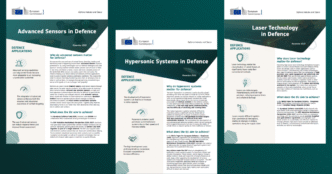
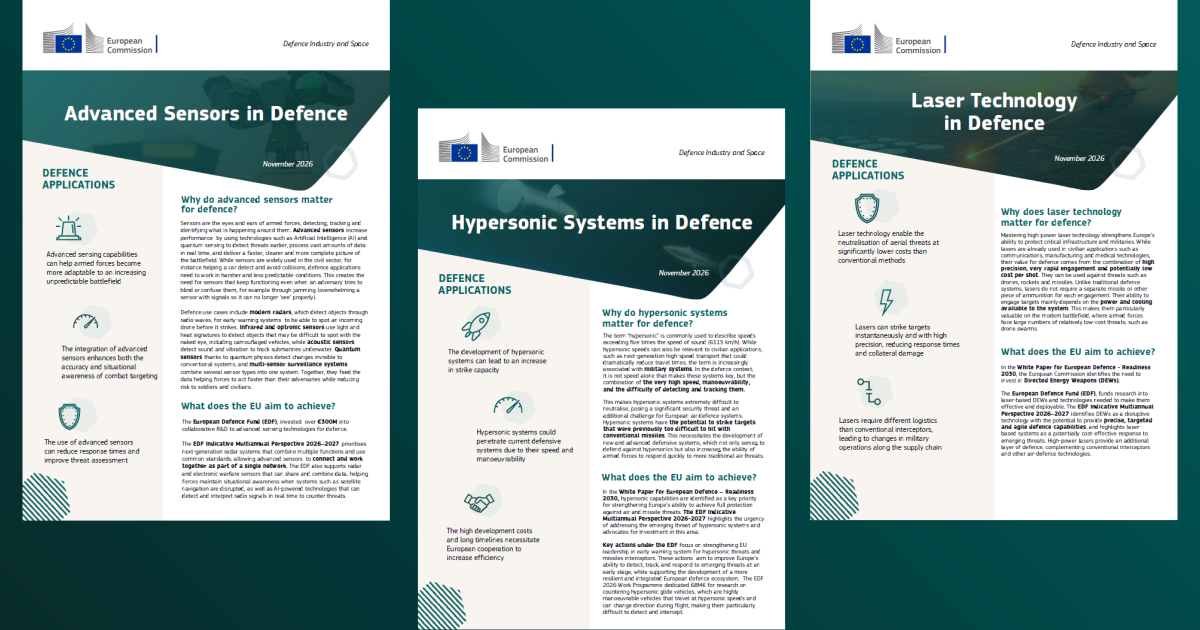
The European Defence Fund funding supports the European defence industry to design, develop, and deliver these technologies. DG DEFIS completed its factsheets series showcasing how the EDF funding allowed European industry to develop technologies accross five priority areas for Defence Readiness:
Advanced sensors
are critical for technologies, such as radar, infrared, optronics, acoustic, quantum and multi-sensor systems used to detect, track and identify threats. Advanced sensors in defence improve situational awareness, speed up threat detection and targeting, and help forces operate in contested environments, including under jamming or disruption. The EU, through the European Defence Fund (EDF), has invested over €300 million in collaborative R&D on advanced sensing, including next-generation radar, AI-enabled signal detection, sensor networking and quantum sensing projects.
Hypersonic systems
are becoming increasingly important in modern defence because they fundamentally change the speed, complexity and timing of warfare. As they operate above five times the speed of sound, especially those combining very high speed with manoeuvrability. They are difficult to detect, track and intercept, creating major challenges for air and missile defence while increasing strike capacity. The EU identifies hypersonic capabilities as a priority, by supporting early warning, interception and counter-hypersonic research, including €68 million in the 2026 work programme for research on countering hypersonic glide vehicles.
Laser technology
One of the most significant challenges facing modern armed forces is the growing use of drone swarms. The economic imbalance between inexpensive drones and expensive missile interceptors creates a major challenge for military planners.
Laser weapons could help address this imbalance as they offer rapid, precise engagement, low collateral damage and potentially lower cost per shot than conventional interceptors. The EU supports laser-based directed energy weapons through the EDF, funding projects such as TALOS, TALOS-TWO and LACE, with the aim of reaching a DEW prototype by 2027.
Nanotechnology
The future battlefield will not be shaped by firepower alone, but by the materials and technologies that give military forces a decisive operational advantage. Nanotechnology is pushing this transformation to a new level It can improve soldier protection, stealth, sensing, explosive detection and defence against chemical, biological, radiological and nuclear threats. The EDF funds projects on multifunctional nanomaterials, smart textiles, adaptive camouflage, advanced coatings and nanoscale defence sensors, with prototypes such as smart textiles and camouflage solutions targeted by 2027.
Next-Generation Communications
Military superiority depends on the ability to communicate, coordinate and act faster than the adversary. Secure, resilient and interoperable communications, including 5G, 6G, AI-enabled networks and laser communications, allow armed forces to exchange critical data in real time, strengthen operational coordination and accelerate decision-making, even in contested and hostile environments.. The EDF supports R&D on secure and interoperable communications, anti-jamming technologies, AI-enabled systems and standardised tactical communication architectures to strengthen Europe’s strategic autonomy and digital sovereignty.
Background:
The EDF has a budget of nearly €7.3 billion for 2021-2027, with €2.7 billion allocated for collaborative defence research and €5.3 billion for collaborative capability development projects that complement national contributions.
The financial support is offered primarily through grants up to 100% of eligible costs contingent on activities involved and a bonus system that considers SMEs, mid-caps, and connection to a PESCO project.
The EDF is implemented through annual work programmes structured along 34 thematic and horizontal categories of actions along the objectives set in the Multiannual Financial Framework 2021-2027.