

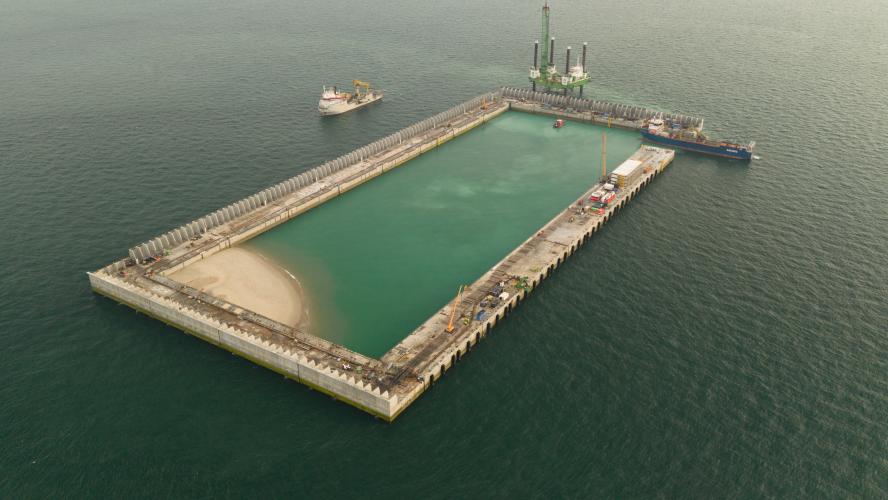
The EIB is providing Elia with €1 billion in green financing for the next phase of Belgium’s Princess Elisabeth Energy Island in the North Sea.
BRUSSELS — Belgium’s Princess Elisabeth Energy Island has secured a major financial boost after Elia Transmission Belgium agreed a €1 billion green credit facility with the European Investment Bank (EIB) for the project’s second phase.
The facility is the largest loan the EIB has ever granted to an energy infrastructure project in the Benelux. It marks a significant step in the construction of the artificial island, which is taking shape approximately 45 kilometres off the Belgian coast and is intended to become a central hub for offshore wind power and cross-border electricity flows.
Record financing for a strategic European grid asset
The new financing follows a €650 million EIB green credit facility agreed in 2024 for the project’s first phase, bringing the bank’s total financing commitment to €1.65 billion.
The EIB is providing the latest facility on favourable terms intended to reduce financing costs and limit the project’s eventual impact on Belgian electricity consumers. Elia made a first drawdown under the facility around the end of July.
Princess Elisabeth Island is designed to connect future wind farms in Belgium’s second offshore wind zone to the national high-voltage grid. It could also accommodate infrastructure for a future electricity interconnector with the United Kingdom, creating additional capacity for cross-border power exchanges.
What the €1 billion facility will finance
The loan will fund key electrical equipment required for the island’s second development phase. This includes a 220 kV high-voltage substation, 66 kV switching stations, transformers and the alternating-current connections linking the offshore hub to the Belgian mainland.
Electricity will be carried ashore through six three-phase 220 kV alternating-current cables connecting the island to an onshore 220 kV substation.
The financing was confirmed shortly after an important construction milestone: the successful installation of the 23rd and final foundation element. Work will now continue on the island’s upper structure, subsea cable links and electrical installations.
Under the current schedule, the island is expected to be ready to transmit electricity from the first wind farms in the Princess Elisabeth Zone from 2031.
Long-term finance as a driver of the energy transition
“Europe is not merely installing turbines; it is rebuilding the backbone of its energy infrastructure,” said Erhan Yurdayüksel, Senior Financial Expert at the European Commission and Chair of the Expert Group at EPA – European Project Agency.
Yurdayüksel said the scale of the credit facility highlighted one of the central challenges facing the green transition: renewable energy infrastructure requires substantial capital at the outset, while returns are generally spread over long periods.
Offshore turbines, subsea cables, substations, transmission networks and storage systems can require investments running into billions of euros. Long-term financing from publicly backed institutions such as the EIB can therefore reduce investor exposure, improve a project’s bankability and lower its overall financing costs.
Energy security, affordability and European integration
EIB Vice-President Robert de Groot linked the investment to the need for a more integrated and resilient European energy system, noting that energy prices remain a major concern for citizens. Expanding grid capacity and connecting additional offshore wind generation should contribute to a more stable electricity market, he said.
Frédéric Dunon, Chief Executive of Elia Transmission Belgium, described Princess Elisabeth Island as a strategic project capable of unlocking a new generation of offshore wind capacity while strengthening energy security and supporting Europe’s competitiveness.
Belgian Minister for Climate, Ecological Transition and Mobility Jean-Luc Crucke also emphasised the importance of expanding low-carbon electricity production and investing in the infrastructure needed for widespread electrification. Such assets, he said, can reinforce Belgium’s energy sovereignty while drawing on the country’s internationally recognised engineering expertise.
Once operational, Princess Elisabeth Island is expected to serve two complementary purposes: bringing new Belgian offshore wind production into the national grid and supporting deeper integration of Europe’s electricity markets. Its longer-term value will depend not only on completing the island itself, but also on delivering the wind farms, cables and interconnections that will make the North Sea an increasingly connected European energy basin.