

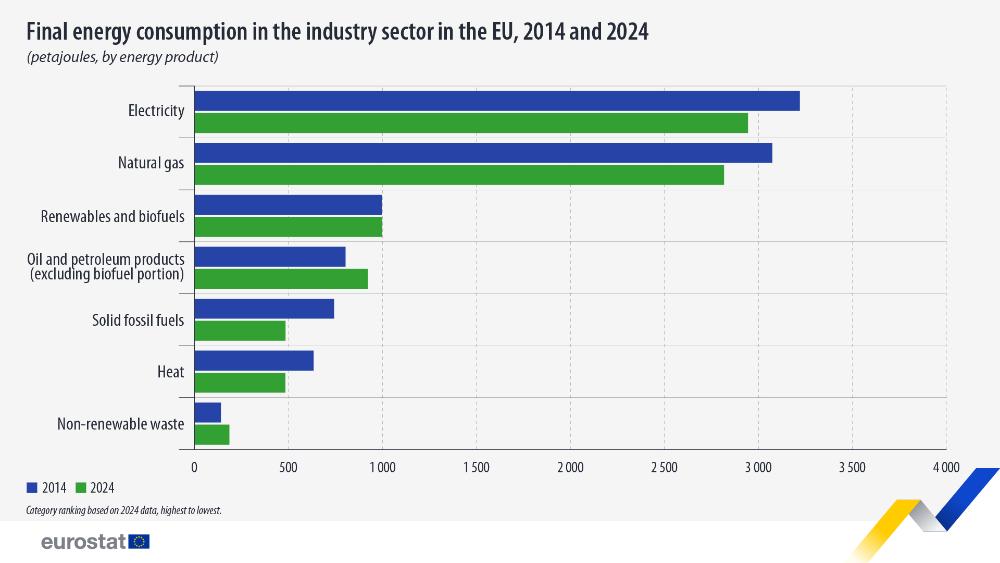
In 2024, the EU’s industry sector used 8 835 petajoules (PJ) of energy, an 8.1% decrease compared with 2014. The final energy consumption has been steadily declining since 1990.
Most of the energy consumed by industry came from electricity (2 945 PJ; 33.3%) and natural gas (2 817 PJ; 31.9%). Renewables and biofuels came third (999 PJ; 11.3%), surpassing oil and petroleum products (922 PJ; 10.4%). The remaining energy came from solid fossil fuels (484 PJ; 5.5%), heat (483 PJ; 5.5%) and non-renewable waste (186 PJ; 2.1%).
Compared with 2014, there was a decline in the consumption of most energy products. The largest relative decreases were in solid fossil fuels (-34.8%) and heat (-23.7%). The use of 2 energy products increased: non-renewable waste (+32.1%) and renewables and biofuels (+24.3%).
Source dataset: nrg_bal_s
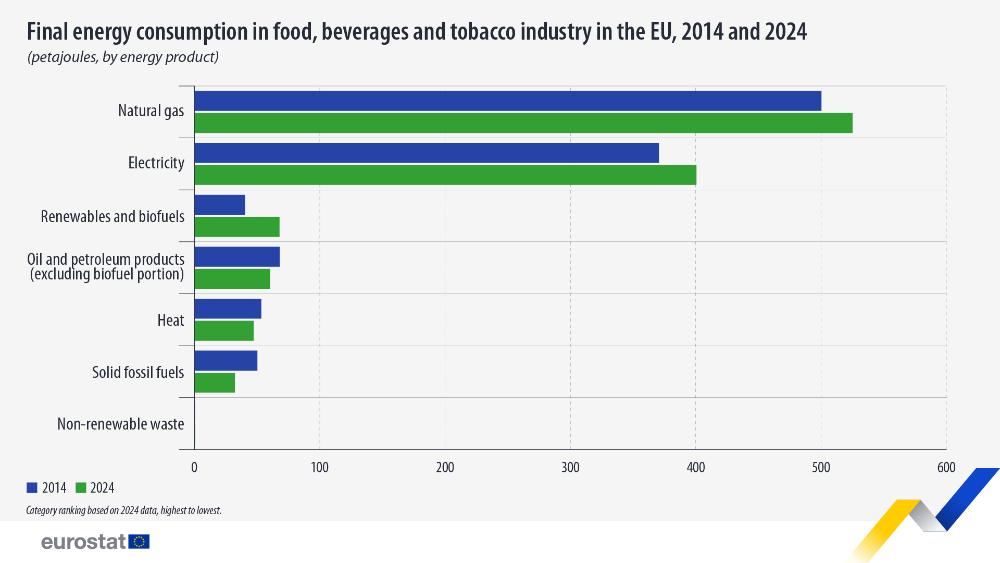
The food, beverages and tobacco industry consumed 1 134 petajoules, or 12.8% of the total industry production. Contrary to the overall industry trend, energy consumption in this sector increased by 4.7% compared with 2014.
Most of the energy used in the food, beverages and tobacco sector came from natural gas (525 PJ; 46.3%) and electricity (401 PJ; 35.3%). The remaining energy was from renewables and biofuels (68 PJ; 6.0%), oil and petroleum products (60 PJ; 5.3%), heat (47 PJ; 4.2%), solid fossil fuels (32 PJ; 2.8%) and non-renewable waste (1 PJ; 0.1%).
The largest relative increase was recorded in the use of energy from renewables and biofuels (+68.4%) and non-renewable waste (+47.4%). However, increases were also recorded for electricity (+8.1%) and natural gas (+5.0%). In contrast, the use of solid fossil fuels declined by 36.4%.
Source dataset: nrg_bal_s