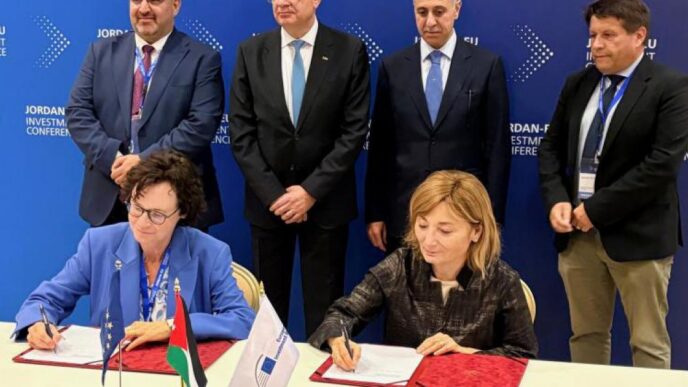



- The European Investment Bank will support the Aqaba–Amman Water Desalination and Conveyance Project with a $400 million project finance loan backed by an EU guarantee, alongside its existing €300 million sovereign loan, a €97 million EU grant and a €30 million Dutch grant, both managed by the EIB.
- In addition, a separate, non-binding letter of intent sets out the EIB’s intention to provide up to €200 million for the National Conveyance Readiness Infrastructure Project, complemented by a proposed €50 million EU investment grant.
- The two complementary projects will create an integrated system to convey 300 million cubic metres of desalinated water a year from the Red Sea to Jordan’s cities and regions.
The European Union (EU), the European Investment Bank (EIB), and the Hashemite Kingdom of Jordan are advancing two complementary investments under the same project to strengthen Jordan’s water security. The Aqaba–Amman Water Desalination and Conveyance Project is a Global Gateway flagship, supported through a Team Europe approach, with the EIB in the lead. It will provide a major new source of drinking water, while the National Conveyance Readiness Infrastructure Project will transfer this supply to the reservoirs, pumping stations and distribution infrastructure serving communities across Jordan.
At the EU–Jordan Investment Conference, the EIB is announcing that it is finalising a $400 million project finance loan with the National Carrier Project Company for the Aqaba–Amman Water Desalination and Conveyance Project. Once finalised, this financing will complement a €300 million EIB sovereign loan and €127 million in EU and donor grant support managed by the EIB, as part of the international financing package supporting Jordan’s largest water investment project, supported by 24 co-financing banks and donors.
Combined financing from the EU and EU Member State institutions for the Aqaba–Amman project is estimated at approximately €1.6 billion, making Europe the project’s largest contributor. This Team Europe support combines EIB lending, EU and Member State grants and financing from European development finance institutions to support Jordan deliver this strategic investment.
The project finance loan will benefit from a European Commission guarantee under the European Fund for Sustainable Development Plus (EFSD+). By sharing risk with the EIB, the guarantee enables greater Bank participation and helps mobilise private investment at scale for strategic infrastructure under the EU’s Global Gateway initiative, reinforcing the EU’s commitment to sustainable development and connectivity.
These investments will help address Jordan’s severe water scarcity. Currently, renewable freshwater availability is approximately 61 cubic metres per person per year, well below the absolute scarcity threshold of 500 cubic metres per person per year. The project will help diversify Jordan’s water supply, strengthen resilience to drought and support public health and economic activity. The Aqaba–Amman project brings together sponsors Meridiam and Suez, international development finance institutions, Jordanian lenders and public financing partners.
Once completed, the Aqaba–Amman project will include one of the world’s largest seawater reverse osmosis desalination plants on the Red Sea, and an approximately 445-kilometre conveyance system carrying water north to Amman and other governorates. Designed to supply 300 million cubic metres of potable water a year, it is expected to meet around 40% of Jordan’s future water needs. This aligns closely with the objectives of the Pact for the Mediterranean, specifically its second pillar, working for stronger, more sustainable and integrated economies.
The National Conveyance Readiness Infrastructure Project, on the other hand, will complement the desalination and conveyance investment by connecting the new water supply to existing water infrastructure. The Ministry of Planning and International Cooperation, the Ministry of Water and Irrigation, the European Commission and the EIB are signing a non-binding letter of intent for the National Conveyance Readiness Infrastructure Project. This letter sets out the EIB’s intention to provide up to €200 million to the Hashemite Kingdom of Jordan, alongside a proposed €50 million EU investment grant to improve the affordability and concessionality of the package. The financing remains subject to completion of the EIB’s approval and contractual processes.
The readiness project is expected to finance strategic transmission pipelines, reservoirs, pumping stations and primary distribution works in Jordan’s northern, central and southern governorates. It is expected to improve reliable access to safe drinking water and reduce exposure to drought for around 11 million people. By enabling the new desalinated supply to be stored and distributed efficiently, it will also help reduce pressure on groundwater resources and improve water services for households. Implementation is expected between 2027 and 2030.
“Strengthening water security is essential for Jordan’s economic development and resilience to climate change. The Aqaba–Amman project will provide a major new source of drinking water, while the planned readiness infrastructure will help ensure that this water reaches the communities that need it. Through our financing and proposed support for the complementary infrastructure, we are working with Jordan and our partners to improve the reliability of water services and reduce pressure on scarce groundwater resources,” said EIB Vice-President Gelsomina Vigliotti.
“Water is life. Through the Pact for the Mediterranean, the Global Gateway and Team Europe, the EU is working with Jordan and partners across the region to strengthen water security. I was glad to join Prince Faisal bin Al Hussein and our partners in Aqaba for the groundbreaking of the National Conveyance Project, designed to meet around 40% of Jordan’s future water needs. We are mobilising €1.6 billion for the project. The European Investment Bank is leading that effort with financing backed by an EU guarantee. A reliable water supply will give families greater security and businesses the confidence to invest,” said EU Commissioner for the Mediterranean Dubravka Šuica.
Background information
EIB Group
The European Investment Bank (EIB) Group is the financing arm of the European Union, owned by the 27 Member States, and one of the largest multilateral development banks in the world. In 2025, the EIB Group signed €100 billion in new financing and advisory services for over 870 high-impact projects under eight core priorities that support EU policy objectives: climate action and the environment, digitalisation and technological innovation, security and defence, territorial cohesion, agriculture and the bioeconomy, social infrastructure, strong global partnerships and the savings and investments union. Beyond long-term loans for large infrastructure, the EIB Group crowds in private investment for high-risk innovative projects and businesses, with a growing role in Europe’s markets for venture debt, venture capital, guarantees and securitisations.
Photos of the EIB Group’s representatives and headquarters, logo files and video B-roll for media use are available here.
About EIB Global
EIB Global is the EIB Group’s specialised arm dedicated to increasing the impact of international partnerships and development finance. EIB Global is designed to foster strong, focused partnerships within Team Europe, alongside fellow development finance institutions and civil society. EIB Global brings the Group closer to local people, companies and institutions through our offices across the world.
The projects and EU support
The Aqaba–Amman Water Desalination and Conveyance Project and the National Conveyance Readiness Infrastructure Project support Jordan’s National Water Strategy 2023–2040. They are aligned with the EU–Jordan Strategic and Comprehensive Partnership, the Pact for the Mediterranean and the European Union’s Global Gateway strategy. The readiness project forms part of the wider National Conveyance Readiness Programme, implemented with support from several international development partners. Other parts of the programme are supported by development finance institutions including Agence Française de Développement and KfW.
Aqaba–Amman project partners
Sponsors: The project’s sponsors are Meridiam and Suez, with the Jordan Social Security Investment Fund expected to join as a shareholder.
International financiers: Alongside the EIB, the financing partners identified in the project’s financing arrangements include the US International Development Finance Corporation, the European Bank for Reconstruction and Development, the International Finance Corporation, the Asian Infrastructure Investment Bank, Proparco, DEG, FMO, the Japan International Cooperation Agency, Cassa Depositi e Prestiti, the Export-Import Bank of Korea, EAAIF, the OPEC Fund for International Development, Swedfund and the Islamic Development Bank, together with Green Climate Fund support channelled through IFC and ILX financing through EBRD.
Public financing and grant partners: Public financing and grant partners include the European Union and the governments of the United States, France, Italy, Germany and the Netherlands.
Jordanian lenders: The Jordanian financing group comprises the Jordan Social Security Investment Fund, the Housing Bank for Trade and Finance, Jordan Commercial Bank, InvestBank, Capital Bank of Jordan, Jordan Kuwait Bank, Bank al Etihad, Jordan Ahli Bank, Arab Jordan Investment Bank, Cairo Amman Bank and Bank of Jordan.