

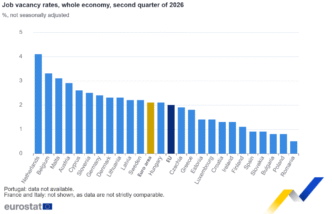
In the second quarter of 2026, the job vacancy rate was 2.1% in the euro area, down from 2.3% in the first quarter of 2026 and down from 2.2% in the second quarter of 2025, according to the figures published by Eurostat, the statistical office of the European Union. The job vacancy rate in the EU was 2.0% in the second quarter of 2026, down from 2.1% in both the first quarter of 2026 and the second quarter of 2025.
Among the Member States for which comparable data are available (see country notes), the highest job vacancy rates in the second quarter of 2026 were recorded in the Netherlands (4.1%) and Belgium (3.3%), followed by Malta (3.1%) and Austria (2.9%). The lowest rates were observed in Romania (0.5%) and Poland and Bulgaria (both 0.8%), followed by Spain and Slovakia (both 0.9%).
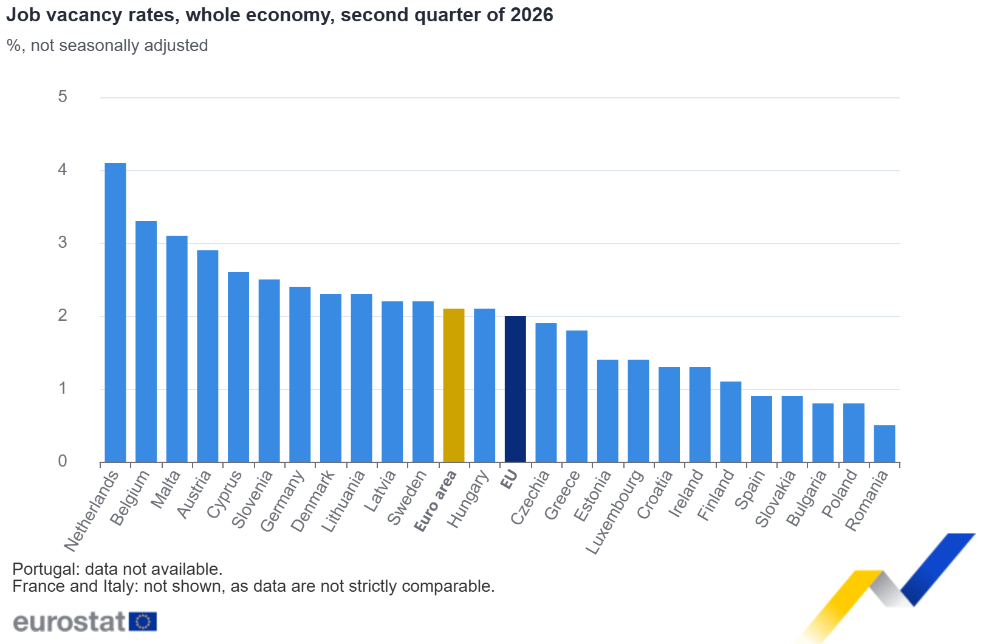 In the second quarter of 2026 compared with the same quarter of the previous year, the job vacancy rate increased in 3 Member States, remained stable in 8 of them and decreased in 15. The increases were observed in Slovenia (+0.3 pp), Greece (+0.2 pp) and Sweden (+0.1 pp). The largest decreases were recorded in Cyprus (-0.7 pp) and Belgium (-0.6 pp), followed by Austria (-0.5 pp), Estonia (-0.4 pp) and Italy (-0.3 pp).
The figure below presents the job vacancy rates of the euro area and the EU by economic activity, in the second quarter of 2026. Data are displayed for the business economy, for which data are available from all EU countries. The highest job vacancy rates, for the euro area and the EU, respectively, were recorded in the following NACE Rev 2.1 sections:
Notes for users
Revisions and timetable
Compared with the rates published in the News Release of 16 June 2026, the job vacancy rates for the first quarter of 2026 were not revised for either the euro area (EA21) or the EU.
Country notes
France and Italy: data are not strictly comparable. In France and Italy, ‘Public administration and defence; compulsory social security’ (NACE Rev. 2.1 section P) is not surveyed while public institutions are not fully covered in ‘Education’ as well as ‘Human health and social work activities’ (NACE Rev. 2.1 sections Q and R).
Denmark: data cover the whole economy (NACE Rev. 2.1 sections B to T) only for the two most recent reference quarters (Q1 and Q2 2026). For earlier quarters, only units within the business economy (NACE Rev. 2.1 sections B to O) were surveyed.
At the time this publication was finalised, data for Portugal and Switzerland were not available for the latest reference quarter (Q2 2026).
Methods and definitions
The job vacancy rate (JVR) measures the proportion of total posts that are vacant, expressed as a percentage:
JVR = (number of job vacancies) / (number of occupied posts + number of job vacancies).
A job vacancy is defined as a paid post (newly created, unoccupied or about to become vacant) for which the employer is taking active steps to find a suitable candidate from outside the enterprise concerned and is prepared to take more steps and which the employer intends to fill either immediately or in the near future. Under this definition, a job vacancy should be open to candidates from outside an enterprise. However, this does not exclude the possibility of the employer recruiting an internal candidate for the post. A vacant post that is open only to internal candidates should not be treated as a job vacancy. An occupied post is a paid post within an organisation to which an employee has been assigned.
Job vacancy rates cover NACE Rev. 2.1 sections B to T. This aggregate is referred to as ‘Whole economy’ for the sake of simplification, even if sections A: ‘Agriculture, forestry and fishing’, T: ‘Activities of households as employers; undifferentiated goods and services producing activities of households for own use’ and U: ‘Activities of extraterritorial organisations and bodies’ are excluded. Sections B to T include the industry (B to E), construction (F) and services (G to O) sectors together with (mainly) non-market services (P to T).
The job vacancy rates for the EU and euro area aggregates are based on Member States data, including estimates for recent periods when values are not yet available. If national data are only available for a sub-population, for example excluding smaller units or some activities, this sub-population is used in the computation of the job vacancy rate for the aggregates.
Geographical information
Euro area (EA21): Belgium, Bulgaria, Germany, Estonia, Ireland, Greece, Spain, France, Croatia, Italy, Cyprus, Latvia, Lithuania, Luxembourg, Malta, the Netherlands, Austria, Portugal, Slovenia, Slovakia and Finland.
The European Union includes Belgium, Bulgaria, Czechia, Denmark, Germany, Estonia, Ireland, Greece, Spain, France, Croatia, Italy, Cyprus, Latvia, Lithuania, Luxembourg, Hungary, Malta, the Netherlands, Austria, Poland, Portugal, Romania, Slovenia, Slovakia, Finland and Sweden (EU27).