

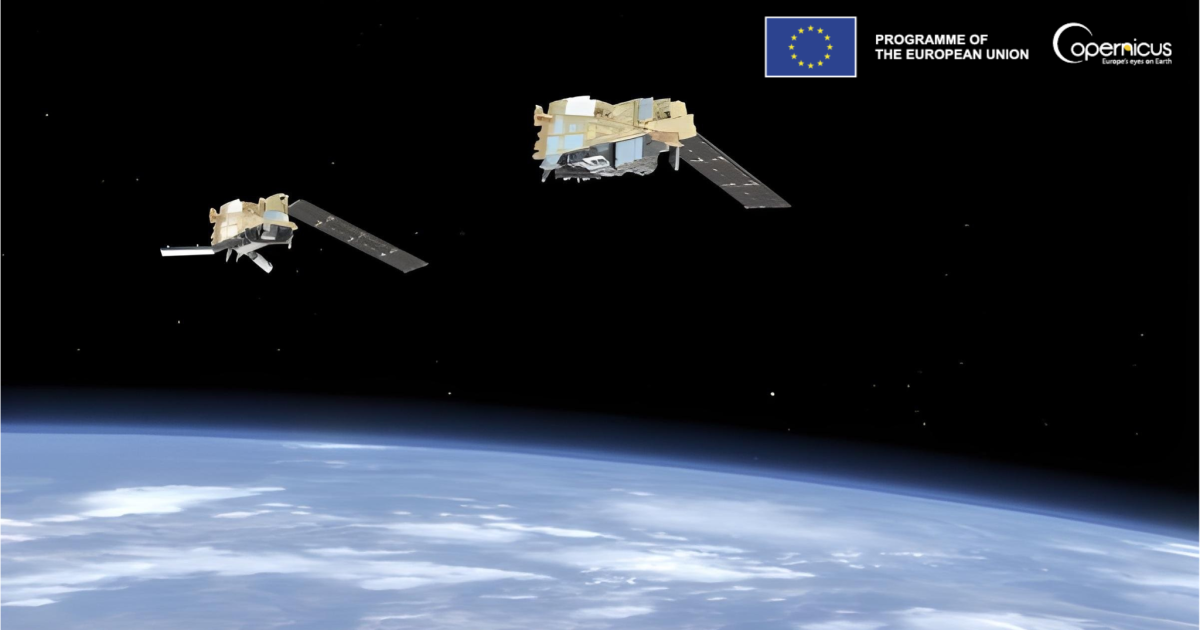
This year has already seen the successful launch of Sentinel‑4A, the first geostationary mission for Copernicus, currently undergoing calibration and testing. Operating from a fixed position over Europe and North Africa, Sentinel‑4A provides high-frequency regional measurements of trace gases such as nitrogen dioxide (NO₂), ozone (O₃), and sulphur dioxide (SO₂), which are essential for understanding daily variation and capturing transient peaks of air pollution throughout the day.
To complement this geostationary view, Sentinel‑5A onboard the MetOp-SG A1 satellite will launch in August 2025, from Kourou, French Guiana, aboard an Ariane 6 rocket. Unlike its geostationary counterpart, Sentinel‑5A will fly in a polar orbit, circling the Earth every 100 minutes and delivering full global coverage every 24 hours.
By improving the Copernicus system’s ability to deliver daily global data on air pollutants and other atmospheric trace gases, Sentinel-5A will significantly strengthen what is already considered the world’s most advanced Earth Observation system for air quality and emission monitoring.
The addition of Sentinel‑5A marks an important advancement in Europe’s capacity to track air pollution and atmospheric composition, with its data feeding into the daily forecasts and long-term environmental monitoring delivered by the Copernicus Atmosphere Monitoring Service (CAMS). Together with Sentinel‑4A, it strengthens Copernicus’s atmospheric monitoring capacity, enabling more precise, frequent, and timely insights into greenhouse gases, atmospheric pollutants, and environmental health in Europe and across the globe.
Continue reading on this week’s Observer