

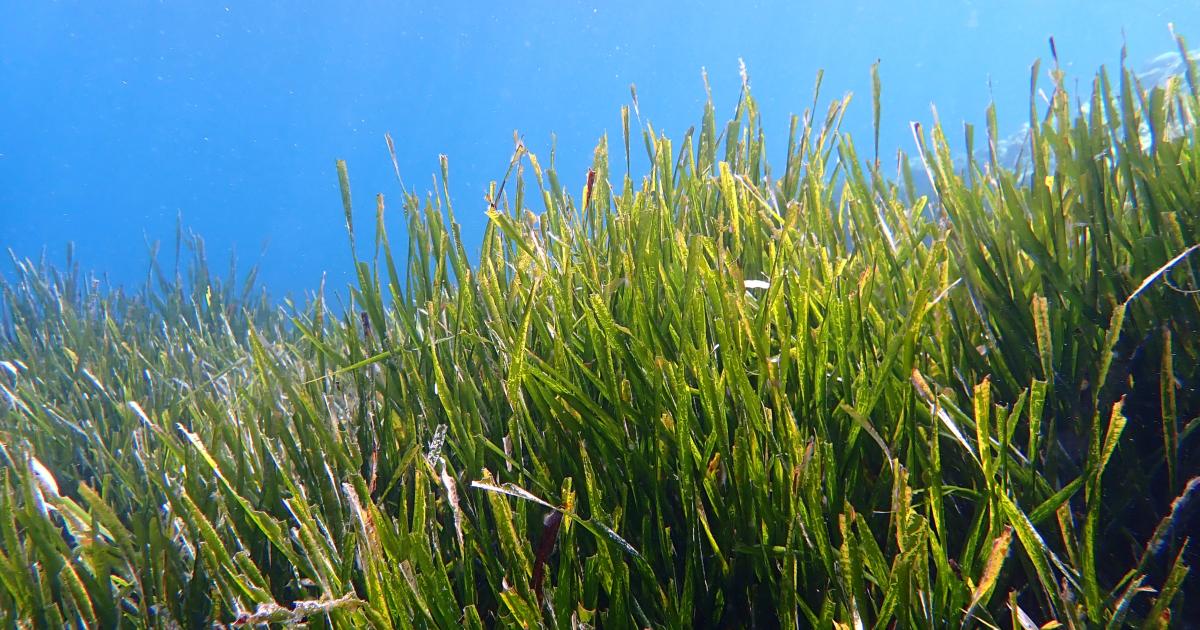
Seagrass meadows, formed by densely growing flowering plants such as Posidonia, Zostera and Thalassia in shallow waters, are key coastal ecosystems. As well as offering important habitat for marine biodiversity, seagrass plays a crucial role in mitigating climate change through carbon storage.
However, these ecosystems are under threat from coastal development, pollution, eutrophication, and climate change, with implications for global carbon stocks. At EU level, conserving and improving seagrass meadows falls under wider legislation such as the Marine Strategy Framework Directive and Nature Restoration Regulation. The EU has also funded research and innovation projects looking at various threats facing seagrass, and published its Blue Carbon Roadmap, which moves towards including ‘blue carbon’ – the carbon stored by coastal vegetation such as seagrasses, tidal marshes, mangroves and seaweeds – in carbon and nature credit schemes (e.g. via the Roadmap towards Nature Credits). Additionally, the UN has called for a redoubling of efforts on seascape restoration to maximise the potential of blue carbon for climate change mitigation.
Much research has focused on how seagrass promotes the accumulation of organic carbon in seabed soils, as opposed to in plant material above and below the soil. Its net primary productivity (NPP) – the amount of organic carbon the plants absorb minus their own respiration – also deserves more attention, say the researchers behind a new study looking at the importance of seagrass meadows in global carbon stocks.
To better understand the role of seagrass in carbon cycling, researchers in Spain analysed a 2023 dataset on seagrass meadow structure, biomass and NPP, drawn from a major literature review covering 1975–2020. They supplemented this with their own review of studies containing original data, including previously unidentified sources. They assigned data points to global seagrass bioregions and compared above- and below-ground biomass and NPP across different types of seagrass (genera) and in different regions.
They estimated global seagrass carbon biomass at 24-40 megatonnes (Mt) – among the highest plant organic carbon stocks on Earth – with NPP fixing 83-137 Mt of carbon annually. Both metrics varied widely by area, bioregion and country. The Mediterranean had the highest seagrass biomass carbon stock per hectare, followed by the Tropical Indo-Pacific and Atlantic, while NPP was highest in the Temperate Southern, North Pacific and North Atlantic East bioregions. With this in mind, the Mediterranean offers a significant opportunity to maximise the climate benefit of blue carbon strategies through targeted conservation and restoration measures.
They reported substantial differences between genera in carbon biomass stocks, with the highest, Posidonia, holding 50 times more carbon biomass than Halophila, the lowest. Long-lived, large, and persistent seagrass species within the genera Posidonia, Enhalus and Thalassia predominate in bioregions such as the Mediterranean and the Tropical Atlantic, contributing to higher biomass carbon stocks per hectare compared to bioregions such as the Temperate North Atlantic and Pacific, which are dominated by relatively small opportunistic (Zostera, Cymodocea) or colonising (Halophila, Ruppia) genera. However, regions dominated by more transient species still play a significant role in the carbon cycle as they have exceptionally high NPP, exceeding that of regions with larger overall biomass.
Based on the study’s estimates, Australia has the highest annual CO₂ emissions from seagrass loss, accounting for 52% of the global total – followed by Spain, Mexico, Italy and the United States. Targeted conservation efforts in these countries would therefore have the most notable impact in delivering the greatest CO₂ mitigation.
Meanwhile, although net seagrass losses in the Temperate North Atlantic East region are high, the associated emissions are relatively low due to a) the limited biomass carbon storage capacity of the dominant seagrass types in this region (Zostera), and b) their limited extent compared to other bioregions. Emissions within the Temperate North Pacific and North Atlantic West bioregions were negligible due to the absence of net seagrass meadow loss in these areas.
The results suggest that the biomass of persistent, long-lived seagrasses should be included in carbon accounting (assuming that conservation and restoration actions contribute to maintaining these carbon pools in a steady state condition, so they are not lost). The researchers note that there are challenges to scientists’ ability to ‘measure’ organic carbon stocks, with extreme variation between locations and stocks changing over time – as illustrated by the broad estimates in the research. Despite this limitation, the improved data published in this study could inform new frameworks for climate mitigation through carbon sequestration, with the work providing a 91% increase in seagrass biomass data and adding data from previously underrepresented regions.
Reference:
Gomis, E., Strydom, S., Foster, N.R., Montemayor, D., Mateo, M.A., Serrano, E., Inostroza, K., McCallum, R., Lafratta, A., Webster, C.L., O’Dea, C.M., Said, N.E., Dunham, N., Bernasconi, R., Werner, A., Vitelli, F., Puigcorbé, V., D’Cruz, A., Salinas, C., McMahon, K.M., Hyndes, G.A., Lavery, P.S., Pessarrodonoa, A., Duarte, C.M., Serrano, O., 2025. Global estimates of seagrass blue carbon stocks in biomass and net primary production. Nature Communications, 16(1), p.9530. https://www.nature.com/articles/s41467-025-64667-6
To cite this article/service:
“Science for Environment Policy”: European Commission DG Environment News Alert Service, edited by the Science Communication Unit, The University of the West of England, Bristol.
Notes on content:
The contents and views included in Science for Environment Policy are based on independent, peer reviewed research and do not necessarily reflect the position of the European Commission. Please note that this article is a summary of only one study. Other studies may come to other conclusions.