


Data extracted in September 2026
Planned article update: September 2027
Highlights
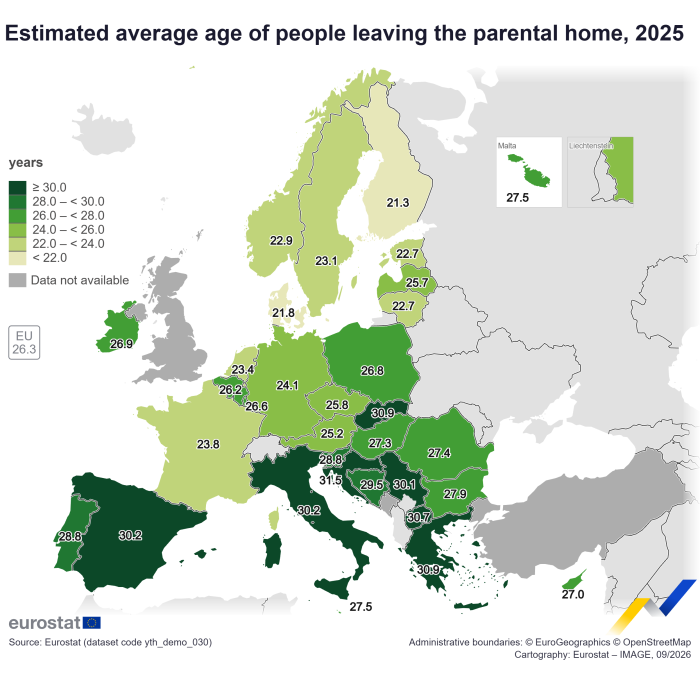
In 2025, people across the EU left their parental home at an average age of 26.3 years, ranging from 31.5 years in Croatia to 21.3 years in Finland.
In 2025, 26.9% of young people (aged 15-29 years) in the EU lived in overcrowded households, compared with 16.8% of the overall population.
In 2025, 9.1% of people aged 15-29 in the EU lived in households that spent 40% or more of their disposable income on housing, compared with 7.7% in the total population.
Across the EU, young people follow very different routes to becoming residentially independent. In countries where they leave the parental home later, overcrowding is often more common. Where they leave earlier, a larger share of young people may face housing-cost overburden. However, this relation can be more complex and varies almost country to country.
Several factors can influence the decision to leave home, including being in a relationship, labour market conditions, cultural norms, and financial aspects linked to housing costs and the overall cost of living.
This article analyses of the average age at which young people in the EU leave the parental home. It also examines 2 closely related indicators that describe young people’s housing conditions: the overcrowding rate and the housing cost overburden rate.

According to the latest Eurostat data, the average age at which people left the parental home was 26.3 years across the EU in 2025, with particularly high values in the south and east of the EU. At the same time, both the housing cost burden and the overcrowding rates remain disproportionately high for young adults: in 2025, 26.9% of people aged 15–29 lived in overcrowded dwellings, compared with 16.8% of the overall population. At the same time, 9.1% of young people lived in households spending at least 40% of their disposable income on housing, compared with 7.7% of the total population.
When do young people leave home?
In 2025, across the EU, the average age of young people leaving their parental home was 26.3. However, this average differed between EU countries. The highest averages, at 30 years or more, were recorded in Croatia (31.5), Slovakia and Greece (both 30.9), and Spain and Italy (both 30.2). By contrast, the lowest averages, all under 23 years, were reported in Finland (21.3), Denmark (21.8), and Estonia and Lithuania (both 22.7). The situation in countries at both ends of this range tends to remain stable over time, reflecting different practices regarding co-residence of generations in EU countries.
Source: Eurostat (yth_demo_030)
When we look at the relationship with the parental household from another perspective, several patterns emerge if we divide young people into narrower age groups (16-19-, 20-24- and 25–29-year-olds – see Figure 1). In Croatia, Italy, Spain, Slovakia, Poland and Cyprus, more than 95% of 16-19-year-olds and 60% of 20-24-year-olds-lived with their parents or either contributed or benefited from the household income. At the opposite end of the scale, in Sweden, Denmark and Finland, fewer than 93% of 16-19-year-olds lived with their parents or contributed to or benefited from the household income. Among 20-24-year-olds, the shares were 42.7% in Sweden, 26.3% in Denmark and 22.3% in Finland. These 3 countries also had the lowest shares among those aged 25-29, 5.4% in Denmark, 5.5% in Finland and 10.5% in Sweden.
.png)
Source: Eurostat (ilc_lvps08)
Overcrowding rate ‒ Staying longer often coincides with less space
In 2025, 26.9% of young people (aged 15-29 years) in the EU lived in overcrowded households.
The overcrowding rate is the percentage of the population living in an overcrowded household. A person is considered as living in an overcrowded household if it does not have does not have enough rooms for the size and composition of the household. The minimum is considered to be:
- one communal (living) room for the household
- one room per couple in the household
- one room per single person aged 18 or over
- one room per pair of single people of the same sex between 12 and 17
- one room per single person between 12 and 17 and not included in the previous category
- one room per pair of children under 12
In 2025, the overcrowding rate for young people aged 15-29 years was 26.9%, 0.4 percentage points (pp) higher than in 2024. In every EU country, young people were more likely than the total population to live in overcrowded households. The overcrowding rate for young people was 10.1 pp higher than the rate for the total population (16.8%). Overcrowding rates differ considerably between EU countries. The highest rates for young people aged 15-29 were observed in Romania (60.4%), Latvia (54.9%) and Bulgaria (52.8%). Rates were also above 40% in 6 other EU countries. At the other end of the scale, Cyprus recorded the lowest rate, at 3.5% (see Figure 2).
.png)
Source: Eurostat (ilc_lvho05a)
The largest differences between the overcrowding rate for young people and that for the total population were in Bulgaria (20.3 pp), Greece (20.1 pp) and Romania (20.0 pp). In relative terms, the differences were greatest in Denmark and the Netherlands, where young people were more than twice as likely to live in an overcrowded dwelling as the total population; in Finland, they were almost twice as likely. Figure 3 shows the overcrowding rate for young people broken down by into narrower age groups (15-19-, 20-24- and 25-29-year-olds).
In general, in countries where the overcrowding rate for young people is high, those aged 15-19 are the most affected. In Romania, Latvia, Bulgaria, Croatia, Lithuania and Greece, more than half of 15-19-year-olds lived in overcrowded households (from 65.5% in Romania to 50.1% in Greece). In most countries, the overcrowding rate decreases with age. The largest difference between 15-19-year-olds and 25-29-year-olds was in Lithuania (22.3 pp), followed by Latvia (20.3 pp), Romania (15.4 pp) and Bulgaria (14.7 pp). By contrast, in Denmark, Sweden, Finland, Greece, Malta, Slovakia, Germany and the Netherlands, overcrowding rates were highest among 20-24-year-olds.
The difference between this age group and those aged 15-19 was 15.7 pp in Denmark, 12.5 pp in Sweden and 12.4 pp in Finland. In other countries with lower overcrowding rates, differences between age groups were generally smaller.
,_by_age_group_(%25).png)
Source: Eurostat (ilc_lvho05a)
Housing cost overburden rate ‒ Moving out can bring higher housing costs
The housing cost overburden rate is the percentage of the population living in households where housing costs account for more than 40 % of a household’s disposable income.
In 2025, 7.7% of the EU’s population lived in households that spent 40% or more of their disposable income on housing (see Figure 4). For young people, the share was 1.4 pp higher, at 9.1%. However, there were substantial differences between EU countries. Croatia (1.5%), Cyprus (2.3%) and Slovenia (3.1%) had the lowest housing cost overburden rates for young people, while Denmark (26.9%) and Greece (25.6%) had by far the highest. Eight countries had rates above the EU average.
.png)
Source: Eurostat (ilc_lvho07a)
In 2025, in 16 EU countries, the housing cost overburden rate was higher among people aged 15-29 than for the population as a whole. The largest difference between the 2 groups was 6.2 pp in the Netherlands, followed by Finland (5.1 pp) and Romania (5.0 pp). In relative terms, the rate for young people was more than twice that for the total population in Finland and twice as high in Romania; in the Netherlands, it was nearly twice as high.
Unlike the overcrowding rate, 8 EU countries recorded higher housing cost overburden rates for the total population than for young people. Among these, Croatia had the largest negative difference (-1.7 pp). Figure 5 provides a more detailed picture by further dividing young people into narrower age groups (15-19, 20-24 and 25-29 year olds).
The transition to independent living is particularly challenging for people aged 20–24. At EU level, 11.1% of this age group faced housing-cost overburden ‒ the highest share among the 3 youth age groups analysed ‒compared with 6.8% of those aged 15–19 and 9.5% of those aged 25–29. In Denmark, the rate reached 34.9%, meaning that more than 1 in 3 people aged 20–24 lived in a household spending at least 40% of its disposable income on housing. Rates were also particularly high in Greece (28.1%), the Netherlands (18.9%), Germany (18.4%) and Romania (17.5%).
,_by_age_group_(%25).png)
Different countries, different housing pressures
In countries where young people tend to leave the parental home earlier, such as Denmark, the Netherlands, Sweden, Germany and Finland (see Map 1), housing cost overburden among young people is higher.
Countries where people move out of the parental home later, such as Cyprus, Croatia and Italy, usually report lower levels of housing cost overburden. However, in Greece, housing cost overburden for young people remains high despite the high average age at which people leave the family home.
Source data for tables and graphs
Data sources
The data used in this article come from the EU statistics on income and living conditions (EU-SILC) and the European Union Labour Force Survey (EU-LFS).
In the survey, a person is counted as part of the parental household if they are
- living with their parents
- working away from the family home during the week but usually returning at weekends
- a primary or secondary school pupil living away from the family home during the school term
- living away from the family home for an extended period for work reasons, but significantly contributing to the household income and not usually residents in another private household
- a higher education student living away from the family home while at college or university, but benefiting from the household income and not usually resident in another private household
The EU-LFS is the largest European household sample survey and provides quarterly and annual results on labour market participation of people aged 15 and over. The EU-LFS uses the same target populations and definitions in all countries, which ensures that results are comparable across countries. Annual results are calculated as averages of the four quarters in the year.
The EU aggregate is a population-weighted average of national figures.
The reference population covered by these data includes all private households and their current members living in EU countries, EFTA countries and EU candidate countries at the time of data collection. People living in collective households and institutions are not part of the target population.
Context
In 2025, there were 73.8 million people aged between 15 and 29 in the EU [1], and, as in many other areas in life, they can face challenges with housing. Housing conditions are a key element of living standards and social integration. For young people starting life away from the family home, finding and keeping suitable accommodation can be a major challenge. In the European Pillar for Social Rights action plan, one of the headline targets is to lift at least 15 million people out of the risk of poverty and social exclusion by 2030.
For each target, a set of indicators was developed to monitor and support the strategy. Housing conditions are included among the indicators related to material deprivation. Housing issues are also addressed in the EU youth strategy adopted for 2019-2027.
Explore further
Other articles
Theme entry page
Online publications
Statistical articles
Database
-
- Youth social inclusion (yth_incl)
-
- Living conditions (ilc_lv)
- Housing conditions (ilc_lvho)
- Material deprivation (ilc_md)
- Housing deprivation (ilc_mdho)
- Living conditions (ilc_lv)